
Posts by Jono Cook
Grand Slam champion Kevin Ullyett talks tennis and influences
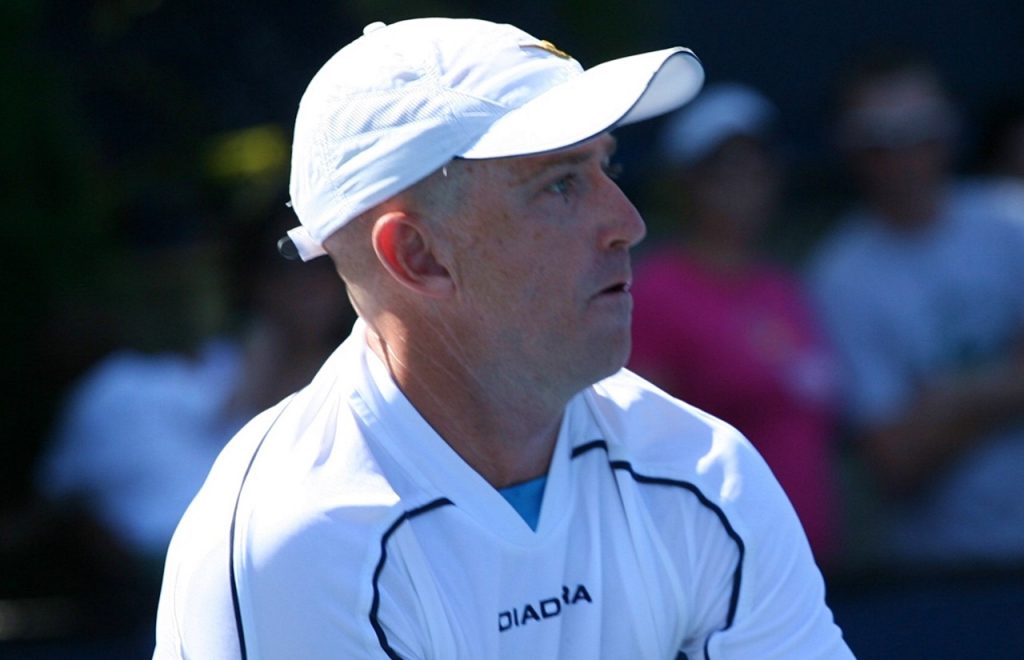
4 June 2020 – Born in Zimbabwe, Kevin Ullyett moved to South Africa at a young age. He attended Atholton Primary School in Umhlanga Rocks before moving on to Beachwood (which less than a year after he finished there amalgamated with Northlands and became Northwood) for high school. At the beginning of his matric year, he left school to pursue a career as a professional tennis player. It proved to be an excellent decision. He spent 18 years on tour, winning 34 doubles titles in total, including three Grand Slams.
Speaking with KZN10.com’s Brad Morgan, he said sport was an important part of life in the Ullyett household. Kevin’s dad, Robert, played Currie Cup cricket for Rhodesia and also represented the country in hockey at the 1964 Olympics in Tokyo. His older brother, Clive, was also a good tennis player who would go on to play professionally, but without achieving similar success to Kevin.
From an early age, the boys were subjected to an active lifestyle and from the latter days of his junior school career that meant early morning tennis coaching for Kevin, between 05:30 and 06:30, under the tutelage of Peter Waters. Then it was off to catch a bus to school at 07:00.
Kearnsey, Northwood share spoils in cracking season-opener
https://kzn10.com/kearsney-northwood-share-spoils-in-cracking-season-opener/

Peter Waters coached Kevin from a young age. He eventually retired in mid-2019 after a coaching career that lasted 55 years.
“As I started putting in the hours,” he recalled, “I started having some decent results and realised I liked it more than the other sports, I suppose.”
Becoming a top junior player meant his holidays were often filled with tournaments. “Every holiday, from under-12, about standard five, I would go to Johannesburg, because it’s always been the place where the tournaments were held. Then, at the end of the year, there were the East London and Port Elizabeth Sugar Circuit events. From under-12 through to under-18, I did that every year.”
Tennis at Beachwood was strong. Practices took place a couple of times a week and then there were matches, too. Westville Boys’ High, at that time, was also exceptionally strong and Kevin often played against those players, who included, among others, Robbie Koenig, Ellis Ferreira, Grant Adams, Kirk Haygarth and Myles Wakefield, all of whom went on to successful professional careers.

Get a firmer grip on your possessions with KZN’s Titan Technologies. https://www.titantech.co.za/
Robbie Koenig, who has become a world-renowned tennis commentator, was a good friend and rival as they grew up. “Robbie and I played so much junior tennis together. We had such good battles throughout our junior career, and we would go and practice together on weekends, all day. He was quite instrumental in my game, because he was probably the best competitor out of all the juniors here, like a Pit bull, never-give-up kind of attitude. He broke my heart so often in the juniors. It toughened me up a lot. We spent so much time together. It was good.”
While Robbie might have broken Kevin’s heart at times, Robbie wasn’t having any of it when discussing Kevin. “Don’t take his BS,” he said with a laugh. “When it really mattered he got one over me in the seniors, when there was big money up for grabs. Over the course of his career, he cost me a boatload of money on the Pro Tour.”
Remembering his time at Beachwood, Kevin said: “We had a really good Headmaster, Mike Ellis, when I was there. Back in those days, there was a lot of structure and quite a lot of discipline. Nowadays, I think the kids get away with murder, but back then there was no stepping out of line. Mike Ellis went on to become a politician for the DA and Mr Robinson, the Vice-Head, stepped in. That structure and discipline helped me in tennis. My dad also got us to focus on a hard work ethic.”
The teachers, too, were really good, he said, and the competition provided by other nearby schools, like Glenwood and Northlands, helped keep the standards high.

At the Inter-provincial Schools Tennis Tournament in Bloemfontein, with Damian Mustard (Pinetown), Garth Furmidge (Michaelhouse), Ryan Fitzwilliam (Northlands), Roger Mills (Westville), Kevin Ullyett (Beachwood), Clint Lishman (Grosvenor), teacher Gary Coombe (Beachwood) and Kirk Haygarth (Westville).
When Kevin reached matric one of the pivotal moments of his life occurred three weeks into the first term. He explained: “During that time, tennis in South Africa was at a stage where there were a lot of local events, challengers and satellites, where locals were getting wildcards, guys like Wayne Ferreira and Marcos Ondruska.
“There were eight to 10 guys who were getting world rankings points and doing really well in those tournaments. They were all leaving school, so I convinced my dad (I don’t know how) that I should leave school as well.
“I completed my schooling through correspondence and split it over two years, so that I could play tennis and travel to all of the events around the country, while I was still under-18. I played against all the Defence Force guys who were doing their national service. That’s what I convinced my dad about and he bought into it.”

Pivotal Talent’s Online SubjectChoice (Grade 9s) and CareerGuide (Grade 10s, 11s and 12s) solutions replaces uncertainty with accuracy in directing your children to make full use of their potential. Check out www.careerguidesolution.co.za
Nowadays, without the tournaments that existed back then, it is so much harder for South Africans to make it onto the ATP World Tour, but at that time the satellite and challenger events drew players from overseas. And the high altitude of Johannesburg favoured the local players, Kevin recalled.
“The conditions in Joburg were quite different and the ball flew around. They weren’t used to that. Living here, it was a great opportunity for the young guys, who were getting wildcard opportunities, to get some scalps of the guys who were coming over and ranked 200-300 in the world. That was a good springboard, but it is much harder now starting out, because you have to fly to other countries and play in tough conditions to fight for points.

Hanging out with visiting players for a Challenger event in Durban. That’s Ryan Fitzwilliam (Northlands) on the right, opposite Kevin, in front.
“If you did well in those tournaments back then, you could pick up 10 or 30 points in a Challenger and ramp up your ranking. It was easier, but now you have to get out there, find some places you can get in. There are also more people playing, and it takes cash to travel now. We were lucky back then that the South African Tennis Federation assisted a lot of the juniors to get into tournaments.”
The fact that a group of talented juniors, many of them from KwaZulu-Natal, were emerging at the same time helped them make the jump into the professional ranks. “That’s key,” Kevin said. “That’s why I think the Spanish and the French have done so well. They’ve had 15 to 20 guys all at once [coming through].

“You don’t to want to lose to the one guy and he makes some points, and you want to match him. It’s a good rivalry to have and we had that, with about six to eight guys in Natal, and then there were the Joburg guys, so there was a good pool of kids. We had the numbers, but I feel they have now dwindled a little and it’s difficult to get that now.”
Support from the national tennis federation also played a crucial role, with a Super Squad, under the coaching of Glenwood old boy Keith Diepraam, featuring Wayne Ferreira, Marcos Ondruska and Grant Stafford, while just below them was the Elite Squad, which included Kevin. It was coached by Kobus Botha.
“Those couple of years, 1991-1994, with Kobus really helped me, especially mentally,” Kevin said. “He was really good on the mental side of competing and we worked terribly hard, and that’s what gave me a good springboard. Peter Waters gave me my whole life as a kid but, when I left Durban and went to Joburg and overseas, Kobus was the one that pushed me to get onto the circuit and to play bigger events.

Coach Kobus Botha (left) played a very important role as Kevin transitioned to life as a professional tennis player.
“In 1995, Kevin Curren coached and mentored me, which was also a key stage in my career. He taught me how to think more of the ‘bigger picture’ and play the right way and not be results/cash-driven, which took some pressure off of me. He encouraged and helped me to put on five kilograms with the help of a trainer in Austin, Texas, to try add more pace on shots and move more explosively. I was very fortunate to have someone like Kevin Curren, who had competed at the highest of levels of the game, guiding me.”
Kevin enjoyed some success as a singles player, with his ranking settling in between 100 and 300 in the world from the time he was 19 years of age. But there was a problem: clay courts. “I was more of a classical player, playing on fast courts. I had to bypass the whole clay season because I couldn’t actually move on the stuff. My results were too inconsistent to keep my ranking at 100 or below on a regular basis. I had to rely on a couple of good weeks every year, and it showed in my singles rankings.”
Some of the older pros, who were playing doubles, suggested to him that he should focus on doubles. He made the decision to follow that path in 2000, strangely enough after his best year in singles in 1999.
“It takes a lot of hard work to stay high up in singles. It was a career decision to hang up my racquet and do something else or to give doubles a crack, like all the other guys were doing, and see what happens. It turned out that I had eight really good years of doubles.
With the benefit of hindsight, he admitted: “I should have done that earlier. I felt I still had something to offer in singles, but the [good] results were too intermittent.”

Young and with a full head of hair, practicing to make it to the top.
Doubles also had the benefit of having a partner. “The singles is more cut-throat,” Kevin said. “In doubles, it’s nice to play as a team. You can practice together. It’s a lot more beneficial. If you just play singles, it can be quite solitary. The doubles’ players generally get on really well. There is a lot of camaraderie.”
Finding the right partner is important, though, especially with matches often being decided by small details and margins. He explained: “It’s like trying to find a girlfriend. What was important to me was finding someone to fit my style of play. I was decent at the net, but I wasn’t as consistent at returning, so I needed someone who could return really well. That’s what I looked for. If saw someone who was solid on returns, those were the people I would target.
“You just have to go up and ask. You just say why don’t we try a few weeks and the worst they can say is no. You try it and work, and then you commit to play the next year, and then you’ve got to give the bad news to your current partner that you’re breaking up with them, and it happens in reverse. Your partner might tell you they’re moving on, which is fine. It’s a career decision. I think everyone understands that. You’ve got to look after number one, unfortunately.”
His doubles exploits started with Pietie Norval, who had partnered Wayne Ferreira to an Olympic silver medal in Barcelona in 1992. “We were mates and we spent a lot of time together in London, and we did well for a couple of years. It was just people I knew,” Kevin said.

Check out the Cell C personal and business contracts at https://www.cellc.co.za/cellc/contracts
Despite leaving Zimbabwe at an early age, the country came to play a role in Kevin’s tennis career and the Black family, which produced professional players Byron, Wayne and Cara, were a big part of it.
Looking back, Kevin said: “We left Zimbabwe pretty early. I remember Wayne, we were a similar age, playing juniors at under-eights. Then I didn’t see him for my whole junior career, but bumped into him again as we were all turning pro.
He and Wayne then formed a very successful doubles partnership, including teaming up to play Davis Cup for Zimbabwe. Their tie against the USA in Harare in 2000 is a match that Kevin reckons was the most memorable of his career.
“It was at the Sports Centre, which had a corrugated iron roof, and we had 5 000 people banging drums in between every point. It sounded like a festival. The Americans included Andre Agassi and John McEnroe was the captain. It was phenomenal. We had a packed Harare crowd and we managed to win 7-5 in the fifth set [against Rick Leach and Alex O’Brien]. That was probably the greatest moment and most intense match I was a part of.” The victory gave Zimbabwe a shock 2-1 lead over the USA, but they were unable to hold on to it and eventually went down 2-3 after a tremendous battle.

When the match is tight and every run counts, you can count of Clox Scoreboards of KZN. http://clox.co.za/
Playing in the Davis Cup brought a different dynamic to competition and it was something that Kevin enjoyed. “It was amazing. Our Davis Cup matches in Zim were always a nice week back there. We practiced hard and the crowds were really vocal and it was fun. We would have a really good time. We didn’t really put that much pressure on ourselves. It was really something to play in a team event for your country.”
In 2001, Kevin and Wayne Black claimed a major title, the first for both of them, when they landed the US Open crown with a 7-6 (11-9), 2-6, 6-3 victory over the American duo of Donald Johnson and Jared Palmer in the title-decider.

New York: Kevin Ullyett and Wayne Black celebrate victory in the 2001 US Open. It happened just two days before the terrorist attacks on the World Trade Centre’s Twin Towers.
Remembering what it took to get there, Kevin said: “We would often get to the quarters or semis, one or two matches away, and it builds up a lot of pressure. In losing a few heart-breakers, you learn some hard lessons and you feel terrible afterwards. But two, three, four years down the line, you get in a similar situation again and the experience from those hard knocks before is valuable.
“You also see mental coaches and follow those kinds of processes to try and put yourself in that situation again and see what and how you would do things differently. That all goes into a mixing pot to improve yourself. Once you got yourself into a similar position again, you were ready.”

It is imperative for coaches to know what works for you. Get in the driving seat with the tried and tested. Contact Trish right now at info@trishsutton.co.za
The following year, in 2002, Kevin captured another Grand Slam title, teaming up with Daniela Hantuchova of Slovakia to takes the honours at the Australian Open. That was an unexpected result.
He recalled: “It was by chance that I played with Daniela. Her coach was a good friend of mine, Nigel Sears, and we were in Cape Town. We used to go there every year before the Australian Open, and she would fly from Europe to practice with him there. I was looking for hits and would hit with her. We put in some practice sessions and just said let’s play some mixed doubles. Our first tournament we played in we won and it was the Australian Open, so it was perfect!”

Kevin and Daniela Hantuchova lift the trophy after claiming the Australian Open mixed doubles title with a convincing 6-3, 6-2 win over the Argentinian pair of Paola Suarez and Gastón Etlis in the final.
His third and final Grand Slam win came in 2005 at the Australian Open when he and Wayne Black beat the most successful doubles team in history, the twins, Bob and Mike Bryan, 6-4, 6-4.
“I always had a dream of winning a Grand Slam. But, if I am honest with myself, I never really thought I would,” Kevin said. “It didn’t feel like we were good enough at one stage, but things started to happen. The next thing we had a Grand Slam title to our name and from there the confidence got really big. Once you’ve achieved that kind of milestone you want to win more. It was a surprise in a way.”
Apart from the three Grand Slam wins, he also made the Wimbledon final in 2008, partnering Jonas Björkman, along with six further semi-finals and 12 appearances in the quarters of the Grand Slams.

Take a 5-star break from life in the fast lane. Contact Fordoun CEO and former Michaelhouse rugby star Richard Bates for your well-earned break. https://www.fordoun.com/
In mixed doubles, he made the Wimbledon final with Daniela Hantuchova in 2002 and made it to the semis with her in 2003. Two years later, he teamed up with former South African, Liezel Huber (now an American citizen), to reach the Wimbledon semis once again. That same year, he and Huber were beaten in the Australian Open final.
On the top rung of the ATP World Tour, Masters 1000 events, he recorded wins in Miami and Hamburg in 2004, in the Canada Open in Montreal in 2005, Hamburg again in 2006, and Paris in 2008. The first three titles were with Wayne Black, who retired after the 2005 season, while the latter two were with Paul Hanley (Aus) and Jonas Björkman (Swe). There were eight further finals appearances, 13 semi-final slots, and 14 appearances in the quarter-finals.

Kevin Ullyett and his long-time doubles’ partner Wayne Black won the Masters 1000 title in Miami in 2004.
During the course of his career, he amassed over 500 victories and was ranked as high as fourth in the world in doubles.
As a fan of the game, he selected two matches as the best he has ever witnessed and both of them were singles finals at Wimbledon: the 1980 final between Bjorn Borg and John McEnroe, which Borg edged 1-6, 7-5, 6-3, 6-7 (16-18) and 8-6, and the 2008 final, an incredible shot-making classic, between Roger Federer and Rafael Nafal which the Spaniard won 6-4, 6-4, 6-7 (5-7), 6-7 (8-10) and 9-7.
In 2004, Kevin married Marylou in Hillcrest. In 2005, their first child, Jemima, was born. As a top sportsman travelling the world, with a child in tow, life had become more complicated.
He explained: “After 9/11 airline travel became so much more difficult, especially travelling with a kid and prams. You would go the airport for a 14:00 flight out of New York and you would get there at 11:00 to deal with the stringent security. It was becoming so tedious, so you really had to work hard on your schedule, and you needed a good travel agent to make sure that you were not flying via this place, via that place, and another.”
Hill Premium Quality Cricket Balls stay the distance. www.hillcricketballs.co.za
Inevitably, Kevin began considering the next step in his life, the one after tennis. Finally, after he made the decision to retire, he ended his career at the 2010 South African Open, partnering Wesley Moodie in the doubles.
“At that stage I was 36 and the travel was getting tough. I was a little over-cooked by then. I had been on tour for 18 years. It was quite a difficult decision, but in hindsight sometimes you get a bit clouded by the travel and losing some matches. That life is actually phenomenal.
“You get into the ‘real world’ and you realise how good playing tennis and making a living is. You’ve got your own time, you’re outside, playing a sport you love, and you’re getting paid.

A sticky wicket makes for messy backyard cricket. Take action before it’s too late. www.midlandssepticservices.co.za
“Just the kids and the travelling and, maybe, being away from them led me to think about doing something else. By default I fell into property development through my brother-in-law and a friend back in South Africa, just as I was trying to figure out what I was going to do for the next 20 to 30 years of my life.”
For a while, he and his young family lived in London following his retirement, and soon another son, Nicholas, was born. They then made a decision to return to South Africa and a home on the north coast. Back in South Africa, Florence, his fourth child, became the only one of his children to be born in South Africa.
Now, with four children – Jemima, Sebastian, Nicholas and Florence – it’s a very different life, revolving around family and plenty of time spent at home. There is time, too, for golf and he’s excelled there, winning the SuperSport Shootout in 2015 and multiple Umhlali Club strokeplay titles.
Travel is no longer an unavoidable part of his life. And Kevin’s very happily enjoying the change.

When it comes to planning your next school sports tour look no further than former Hilton College first XI captain Craig Goodenough who’s been there, seen the movie and bought the T-shirt factory.
Saints’ old boy SJ Erwee is a Dolphins’ stalwart
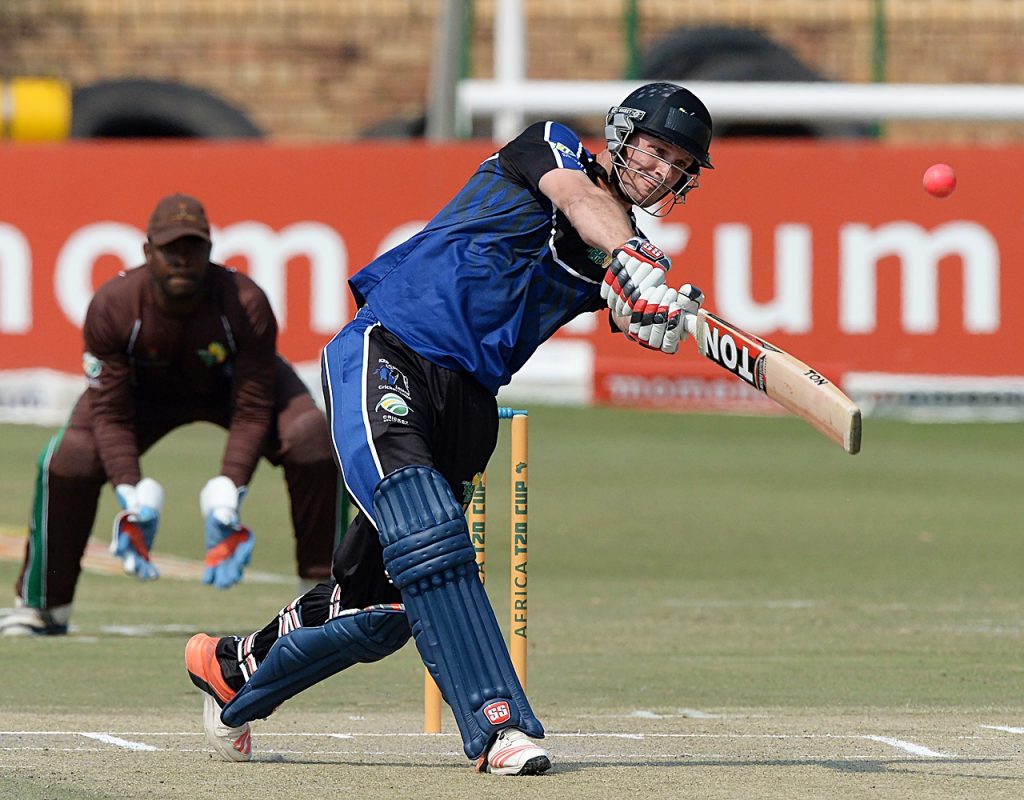
Saint Charles’ old boy SJ (Sarel) Erwee has been one of the most successful and consistent Dolphins’ batsmen of recent seasons, bringing stability and runs to the top of the order, and performing well in all forms of the game. KZN10.com’s Brad Morgan caught up with him to talk about how his former school had helped develop his love for the game and about how he became a success at franchise level.
His home language was Afrikaans, so he attended Piet Retief in Pietermaritzburg until the end of grade three, before switching to Pelham from his grade four year on. During his time at Pelham, while playing in Midlands’ cricket trials at Saint Charles, he scored 60, an innings that was witnessed by two Saint Charles’ matric boys, Glenn Addicott and Brad Moses, both of whom would go on to play for the Dolphins.
Afterwards, they asked him which school he was planning to attend for high school. His initial thoughts had been Maritzburg College, but, he admitted, he was not about to tell the two Saint Charles’ boys that. They told him they would help make sure he moved to the school. Then, when he thought about it, as an Afrikaans boy, Saint Charles began to make a lot of sense.
When the match is tight and every run counts, you can count of Clox Scoreboards of KZN. http://clox.co.za/
He explained: “I think, as an Afrikaans boy going into an English school, you’re looking for a bit more one-on-one help, in case you’re battling with school work when it’s your first time in an English class. Saint Charles had small classes, maximum of 20 in a class, so you got individual attention if you needed help. That was what drew me toward the school, knowing I would survive in an English environment as an Afrikaans boy.”
Also, the two matric boys had made a very favourable impression on young SJ: “Having matrics caring for youngsters and wanting them at their school, that was quite special as well,” he said.
SJ’s dad, Sarel, had enjoyed a successful career as a provincial rugby player, and it was his favourite sport, but when SJ said he wished to concentrate on cricket, his dad backed his decision.
“As a youngster, I guess all parents want you to do well and they obviously push you to do well, and they do what is necessary to give you the best opportunity to do well, things like extra coaching. As a sportsman, he wanted that for me. He was very strict as a father, but very supportive. He knew what it took to succeed at a higher level.”
“He wanted the best for me and my cricket. Whatever it took, he was that pillar that supported me in those decisions. Him knowing what it took, and the things that you need to stay away from if you wanted to make it in sport, I learnt from those things. He kept me grounded.”
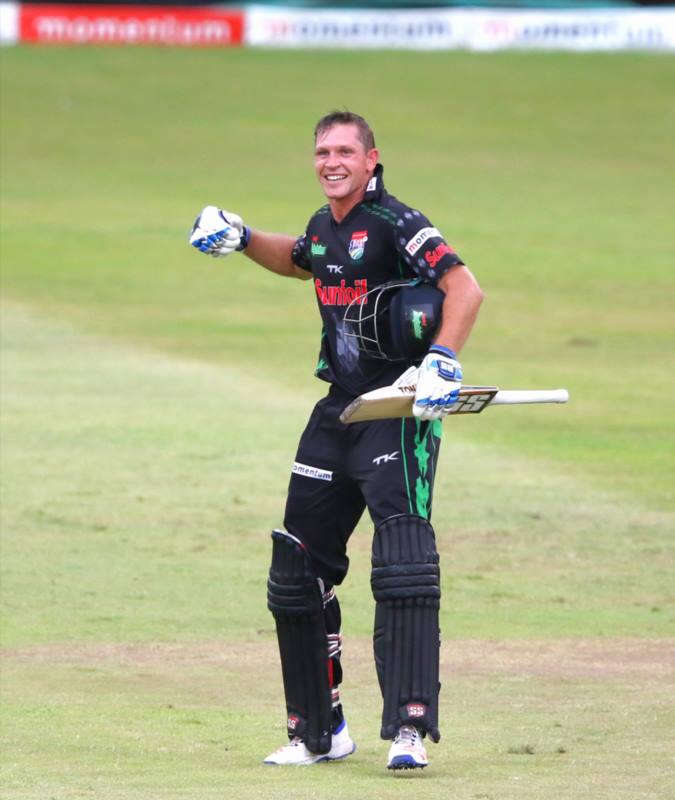
Celebration time with the Dolphins.
Another big influence on SJ was Saint Charles’ 1st XI coach, Dave Karlsen. “He believed in me from a young age,” SJ said. “I started training with the first team at the end of my grade eight year. I trained with them for a bit during my grade nine year. I think I played a couple of games in the Michaelmas Week in grade nine. He always believed in me and pushed me. During PE lessons, he would actually do a bit of coaching with me. He saw the potential in me from an early age.”
He was also encouraged by other boys at the school. “The brotherly community and family attitude at Saint Charles was nice. We had a lot of guys, like Glenn Addicott, who helped me. Also, his brother Denzel and Brad Moses, they were always willing to help and willing to throw balls. There were a lot of senior guys (they know who they are) when I was a youngster at first team practices willing to learn, and they were willing to give advice and willing to help.”
During his time at Saints, SJ earned provincial representation for KZN Inland at under-15, under-17 and under-19 level, which he achieved for two years in succession.
Straight out of school, he joined the Dolphins Academy, but on his arrival there he realised he would need to adjust his goals. He explained: “I used to be a bowler that could bat a bit. When I went to the Dolphins Academy, there were much better spinners than me; Keshav [Maharaj] was there. Our Academy coach just said to me, ‘You can bowl, but work on your batting’.
“I suppose I just fell a bit more in love then with batting than bowling. It was more fun batting and whacking bowlers than bowling. That’s when I changed into a batter.”
When it comes to planning your next school sports tour look no further than former Hilton College first XI captain Craig Goodenough who’s been there, seen the movie and bought the T-shirt factory.
During his time at the Academy, SJ made his first class debut, but it was a hit and miss affair, and he was in and out of teams. KZN Inland, where he was to later enjoy a lot of success, was not run in an especially professional manner.
“I was batting at three, then at seven, then nine, then five. I was all over the show, so I never really had a set plan about how I wanted to bat and where I wanted to bat, because I was chopping and changing week in and week out. That probably affected my stats negatively,” he said.
His cricket career, though, took a decided turn for the better when Grant Morgan joined Inland as coach from the 2012-13 season. His leadership and coaching turned the fortunes of the long down-trodden team around and soon they were winning trophies, something which had appeared unthinkable previously.
SJ was batting at five when Morgan arrived at Inland, but the new coach had seen something in the left-hander and pushed him up the order to number three. He explained to SJ how he wanted him to play, told him to back himself, and assured him he would stay at three for the rest of the season. With that, SJ’s game began to mature.
“Then I figured out I didn’t want to play for Inland for the rest of my career. I wanted to move up.
Hill Premium Quality Cricket Balls stay the distance. www.hillcricketballs.co.za
“I had a look at the Dolphins side and where there could be an opportunity. I am very good friends with Divan van Wyk and obviously Imraan Khan, our coach now, we get along very well. We had a good relationship when they played for Inland and they’ve helped me quite a bit through my Inland career and my cricket career. I have got a lot of respect for them. I still speak to Divan and ask them for advice, likewise with his brother, Morné. They’ve helped me a lot.”
“I saw the middle order was packed with youngsters and guys that were consistently doing well. But there were only the two openers, Divan and Imraan, and I thought there was an opportunity there. I was going to try and take it. If it worked out, I could have a successful career. If it didn’t, well I gave it a bash. Divan and Imraan were very supportive of that. It seemed to work out.
“Whenever they were playing for the Dolphins, I would open for Inland. Things started going nicely and they were backing me. In the training sessions, they would help me. We would train with the new ball and they would tell me what it takes, the mind-set and technique. It’s funny how it works out that way.”

SJ Erwee has excelled in the shorter forms of the game, averaging over 40 in the 50-over format. (Photo: Hollywood Bets Sports Blog https://blog.hollywoodbets.net/)
Another important event in his development occurred when SJ was appointed captain of the KZN Inland team. At the time, Grant Morgan was moving to take over the Dolphins, while former Inland captain Shane Burger took up the reins as coach of the side.
“They thought if I captained the team it would give me a bigger responsibility to actually take things more seriously. It ended up exactly that way. I felt that it wasn’t just about me personally as a player trying to do well. I was doing it for the team. That’s where Grant Morgan changed the whole Inland set-up. That’s how we started to win trophies, by playing for each other. We ingrained that into our game plan.”
The one thing that was missing, though, was a century. Many times, SJ would make an eighty or a ninety, but then miss out on three figures. In February 2016, that all changed and when he achieved the milestone he went very big.
Facing a decent Namibian team in a Sunfoil 3-Day Cup match in Pietermaritzburg, he and Divan van Wyk put on a huge 306 runs for the opening wicket before Van Wyk departed for 152. SJ, though, was far from done. Coach Shane Burger had predicted that he was due for a big innings and it duly arrived as SJ, in a knock lasting almost seven hours, struck 23 fours in an innings of 200 not out.
“To get a double-hundred after getting a lot of eighties and nineties the years before, there was a sense of relief,” he said. “I also felt like I wasn’t finished. I was relieved, but there wasn’t any massive celebration. But it was a case of this is what it feels like, I need to get more and more. Then the celebrations become a bit bigger and you feel a bit happier. To get a double-hundred was nice, but it was the start of everything.
“Once I got that double-hundred, I then got a list A hundred for the Dolphins, and then a first class hundred the week after that, for the Dolphins again.

Attention to detail separates the best from the rest. Talk to the experts. http://www.hilliarandgray.co.za/contact/
“You get a taste of something and you pick your way through your innings afterwards and see what you did right, what you can do better. You find a process and that’s what clicked for me. Those are processes that you try to repeat day in and day out. That 200 just kick-started me.”
The Inland team also taught SJ life lessons about the vital role of teamwork in cricket, and about taking knocks but then getting back up and fighting. Many of the Inland team were players that other provincial sides had rejected, but they pulled together and won both the 3-Day and T20 provincial titles, convincingly defeating teams that had once deemed them not good enough.
“That’s what Grant Morgan instilled in us. With him getting Shane Burger there, he was a great leader, a great human being, and a great coach afterwards. Our blueprint was yes, you get rejected somewhere else, and things might not go your way, but ultimately there is more to life than just cricket and being successful on the cricket field. It’s the relationships you build around you. You train together every day. You might as well have a good time with each other. That’s how friendships build. Most of us stay in contact with each other, wherever we are around the world, because of the relationships we built in that team during that era.”
Morgan and Burger played crucial roles in SJ’s growth and he regards both men as mentors who were able to extract the best out of him.

On the attack for KZN Inland in the Africa T20 Cup, which the team won in 2017. (Photo: Hollywood Bets Sports Blog, https://blog.hollywoodbets.net/)
One of the most important lessons from Grant Morgan, which he carries with him still, is something one of Morgan’s coaches had told him: You make your mark before lunch, you get in after lunch, and you score your runs after tea.
“That’s the kind of mentality that instilled in me,” SJ said. “Even in the white-ball format, you don’t have to go to a 150 strike rate from the start. Get yourself in and batting gets a touch easier. I’ve tried that over the years and it seems to work.”
In 2017, he had the rare opportunity to represent South Africa in the Hong Kong Sixes. “The Hong Kong Sixes was incredible,” he reckoned. “I watched it as a youngster and it was always something that looked like fun. It was incredible. You saw a small field and balls flying everywhere.
“The guys were had in our side were good guys. We had a lot of fun over those four or five days and we won! I don’t think anyone expected us to win. We got sent to the airport and that was the first time we met with each other. We didn’t have any travel kit. We got to Hong Kong and tried to enjoy our trip. It’s not every day you get to go to Hong Kong and just whack a ball around while experiencing a new country and a new culture. We tried to make the most of the days we had there. It seems like if you try to enjoy something you’re going to do well and that is exactly what happened.”
And even though it wasn’t a major tournament, it was still special to represent the country. “When you hear the national anthem playing and you hear your name announced as playing for South Africa, it is still a privilege. It’s not the ‘real thing’, but to know there are seven of you representing South Africa at a world tournament is quite cool.”
Check out the Cell C personal and business contracts at https://www.cellc.co.za/cellc/contracts
The coronavirus pandemic has prevented SJ from playing club cricket in the UK this season, but he is hopeful that will happen next year. Coming up, hopefully, though, is duty for the Dolphins. “I think I’ve got to be back in Durban for training on the 15th [of June]. We’ll train in small pods.”
As one of the more established players in the team, and as someone now into his thirties, he still continues to lead, but simply through the example he sets for the younger players.
“As the younger guys come through, they talk to you about things. They look at what you do and not just what you say. We have got a lot of leaders in our side, older guys or more experienced guys. Leadership is not always just about talking, it’s about doing. If I keep performing, training hard, and setting the example for the guys coming through, that’s also leadership.”

SJ remains a faithful supporter of Saint Charles and an inspiration to the boys of the school.
While his school days are long past him now, SJ says there are lessons from Saint Charles that he has carried with him throughout his life. “Saint Charles is a small school. There are a lot of talented and hard-working people at the school. You are expected to show good manners as a Saint Charles’ boy and you need that a lot longer than sporting achievements, because sport only lasts for that long. Life after sports and the relationships you build during your sporting career are very important. Humility and manners, how approachable you are to people are very important.”
He maintains close ties with the school and eagerly follows their cricket programme, which has enjoyed some outstanding successes in recent times, including winning 21 matches in succession in 2019 and reaching the final of the National Schools T20 competition.
“I am very excited to see what Saint Charles is achieving,” SJ said. “It’s nice to see Morné van Wyk as the cricket pro. It shows how seriously they are taking their cricket and it’s shown in how well they have done over the last couple of seasons. Morné will only do good things there. He has always been a hard worker and he has got different ideas and techniques, which will help the kids, not only at school, but also after school.
“I am very, very excited. I follow the sport at Saint Charles closely. I try to stay in contact with the Master in Charge of Sport, Rowan Irons, and Morné. It is brilliant to see how well they are doing and what is going on at the school.”

Ex-Clifton hockey ace Matt Lewis thriving Down Under

29 May 2020 – Matt Lewis was a standout, highly skilled, all-round performer for Clifton in 2018 when the school went through the hockey season unbeaten before losing their very last game of the season, which he missed through injury. His contributions on the field throughout his Clifton career were eye-catching and memorable, leaving many predicting a bright hockey future for him. That future, however, is not in South Africa, writes KZN10.com’s Brad Morgan.
In 2019, Matt and his family moved to Australia with one of the primary reasons being to give him a chance to pursue his hockey dream.
Thoughts of moving Down Under started in 2016 when he went to Brisbane for a school exchange. “I just loved the country and the quality of hockey that they play at and I thought that’s it, we have to move here,” he said.
When the match is tight and every run counts, you can count of Clox Scoreboards of KZN. http://clox.co.za/
With his father, Terry, being an Australian citizen, and Matt a truly gifted hockey player, the family began to look into the possibility of the move. But grade 12 had to be dealt with first. “I wanted to finish school first as I felt matric was an important part of my life and I was extremely close with my friends,” Matt said.
“In 2019, the move began to Australia and my family is loving it here. My mom and I have just recently become permanent residents, which is awesome to have as there are so many benefits from it, and it gives us a sense of belonging here.”
Matt, who attended Clifton from grade R to matric, began playing hockey at the age of six at Riverside Hockey Club. It was the nature of team sport that captured his heart and a burning desire to win. “I have not looked back since,” he reckoned.
The foundation he received at Clifton was integral to his development, he said, citing very strong coaching from experienced coaches, which is “exactly what players want”. There was also a very important lesson to always be humble in striving for achievements.
At Clifton, Matt played in the first team from 2015 to 2018 and earned selection for the KZN Coastal and South African under-16 A teams in 2015 and 2016 and the KZN Coastal under-18 A side in 2018, when he was also chosen for the SA Schools B Team.
Missing from the above is 2017. That’s because Matt suffered a knee injury that needed surgery. It had been tough, but he wasn’t concerned that he would no longer be able to perform to the best of his ability. “I was more excited than ever to get back into hockey in 2018, I had absolutely no worry about my knee going into 2018 as I had done all the right rehab that would allow me to be 100 percent,” he said.
Inspirational captain leads Clifton basketball’s rise
https://kzn10.com/inspirational-captain-leads-clifton-basketballs-rise/
Matt received the Hockey Player of the Year award from Clifton in 2018.
Blessed with good finishers and a gritty defence, Clifton put together a superb season under the guidance of coach Keegan Pearce, who Matt credited for helping him take his game to the next level.
They played 24 matches, won 20 of them, drew three and lost only their last game, when they had to play without goal scoring aces Matt and striker Declan Bradfield.
“The loss to Michaelhouse was a tough one to watch from the side line as I ruptured my ATFL ligament in an ankle,” Matt recalled.
But there were many highlights as the Clifton first team put up almost four goals a game on average, while conceding just less than one. Interestingly, during the season they played five schools twice – Saint Alban’s College, Uplands College, Saint Stithian’s College, Saint Andrew’s School, and Saint David’s Marist Inanda – and in every case won by a better margin the second time around, which showed progress and the ability to learn lessons from previous encounters.
Their three draws came against Cape Town powerhouse Bishops Diocesan College (1-1), a loaded Maritzburg College team (1-1) and Saint John’s College (2-2).
Check out the Cell C personal and business contracts at https://www.cellc.co.za/cellc/contracts
Maritzburg College, as a long-standing national power, was always a game that brought the Clifton team extra motivation, said Matt. So a 1-1 draw in Pietermaritzburg was a good result. Saint Charles, which has a lot in common with Clifton, was another game that the team always got themselves up for, he added, while Northwood and the Durban north derby was also a big one.
“My most memorable match of 2018 would probably have to be the 2-1 win against Northwood as they had a good side and I had a lot of mates in their team, so it was nice to get one over them.”
In May 2018, he was interviewed by KZN10.com’s Jono Cook, with whom he shared one of his goals: “Winning gold at [the under-18] IPT is another goal on my mind as I feel we, as KZN Coastal, have a very strong team to do so.”
In a tournament that underlined the strength of hockey in the province, the final came down to a showdown between KZN Coastal and KZN Inland, with Coastal coming away with the win. Mission accomplished, goal achieved.

A tale of two teams: the victorious KZN Coastal team celebrates after defeating their rivals, KZN Inland, in the final of the Under-18 Interprovincial Tournament in Pietermaritzburg in 2018.
His most memorable match ever with Clifton, he revealed, had taken place in 2016 on an overseas tour of the Netherlands and Belgium, two of the leading hockey-playing nations in the world. There, Clifton made the final of an under-18 tournament, where they faced the Polish national team in a game which they lost after a penalty shootout. “I had never seen so many people watching the game. It was just unreal,” he said.
In matric, Matt was selected to represent South Africa in the Africa Youth Games, which was another highlight in a career that had already included many.

Clifton recognised Matt Lewis’ achievements in hockey when he shared the 2018 Sportsman of the Year Award with William Dowsett and Todd Howard, who represented South Africa in waterpolo.
“I was extremely fortunate enough to go to a school like Clifton and I encourage every boy at Clifton to make the most out of it and wear the badge proudly,” he said in a message for the Clifton family.
With matric completed, the Lewis family made the move to Perth, Western Australia, which is a hot bed of Australian hockey. Matt explained: “The hockey system in Australia is just on another level and it shows in the results that the Kookaburras [men’s national team] and Hockeyroos [women’s national team] have achieved over the years.
Indeed, the Kookaburras have long been one of the world’s great teams, compiling a superb record that includes being the three-time World Cup winners, one-time Olympic champs, three-time World League winners, champions of the Pro League last year, and 15-time winners of the Champions Trophy.
“All the men’s and women’s national players live in Perth, so that they can train together. This means that the clubs will receive national players based on how many draft picks they have. This allows the competition to be extremely strong as you play against some of the best players in the world every weekend.
“The school boy level in KZN is stronger than here because all the hockey is played at club level here.”

The standard of play that Matt Lewis is facing in Australia is reflected in this photo of him in action for Hale Hockey Club: Matt is in possession, about to take a shot, and the man on the right is Matt Swann, who is closing in on 200 caps for Australia.
The fact that the move to Perth, which is known for having a large community of South Africa expats, went smoothly was a great help. “I knew only a handful of people coming over, but my dad knew loads of people who were his mates from school. I can’t thank them enough for making our move so easy.”
A smooth transition was also aided by former South African goalie Dave Staniforth and Jamie Dwyer, who knew about the Lewis family’s move and Matt’s hockey prowess. Not bad when one of the greatest to ever play the game is there to help.
Matt plays for Hale Hockey Club, which is coached by Staniforth. Last year, they made it to the league final where they were beaten by WASPS Hockey Club. In 2019, he was also selected to play for the Western Australia under-21 team that finished third in the Inter-state Championships. Sadly, those have been called off this season.
Take a 5-star break from life in the fast lane. Contact Fordoun CEO and former Michaelhouse rugby star Richard Bates for your well-earned break. https://www.fordoun.com/
Another big feather in Matt’s cap was receiving an invitation to train at the Western Australian Institute of Sport where he got to spend time playing, training and conditioning with some of Australia’s best juniors.
Matt’s currently doing a Bachelor of Finance degree at Edith Cowan University, with his studies and hockey being his main focuses.
He has set his hockey aim high: “My long term goal is to one day play for the Kookaburras. It would be a dream come true as it has been a goal of mine for some time now.”

Matt Lewis on the run, taking the game to the opposition.
CLIFTON 1ST XI 2018
Clifton 7-1 Thomas More College
Clifton 9-1 Fourways High School
Clifton 6-1 DHS
Clifton 5-1 Saint Alban’s
Clifton 1-1 Bishops Diocesan College
Clifton 4-1 Uplands College
Clifton 3-2 Saint David’s Marist Inanda
Clifton 5-0 Saint Stithian’s College
Clifton 2-2 Saint John’s College
Clifton 5-0 Uplands College
Clifton 3-1 Nelspruit
Clifton 4-2 Saint Andrew’s School
Clifton 3-0 Saint Alban’s
Clifton 7-1 Trinity House
Clifton 2-0 Crawford College La Lucia
Clifton 4-1 Saint Charles College
Clifton 3-0 Glenwood
Clifton 2-1 Northwood
Clifton 1-1 Maritzburg College
Clifton 5-1 Saint Andrew’s School
Clifton 7-1 Saint Stithian’s College
Clifton 1-0 Helpmekaar
Clifton 3-1 Saint David’s Marist Inanda
Clifton 1-2 Michaelhouse
Played 24, won 20, drew 3, lost 1, goals for 93, goals against 22
A sticky wicket makes for messy backyard cricket. Take action before it’s too late. www.midlandssepticservices.co.za
Westville swimming phenom Luca Holtzhausen dreams big
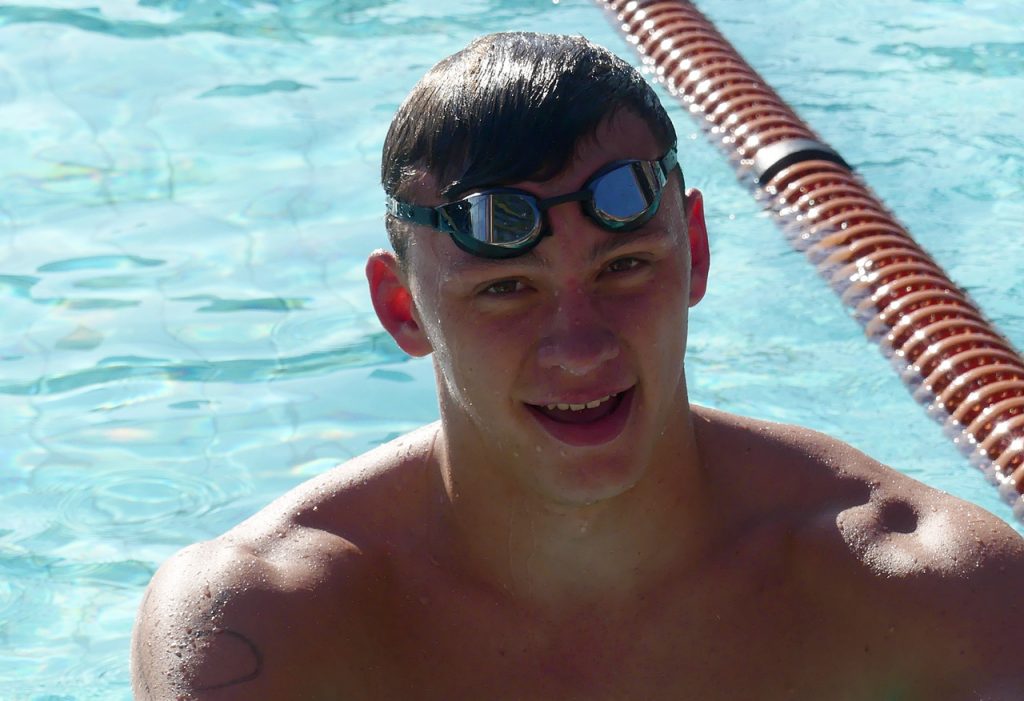
20 May 2020 – When Chad le Clos blazed his way to multiple swimming records in his time at Westville Boys’ High it was reasonable to expect that they would last many decades. Yet, only a decade later, incredibly, many of his records are falling to grade 10 learner Luca Holtzhausen, writes KZN10.com’s Brad Morgan.
A chat with Luca at the school, just before it closed due to Covid-19, suggested that there could be significantly more to come from the 16-year-old standout when, while discussing the demands of training, he admitted: “I will say that towards the end of last year I told myself that this is what I want to do and nothing else. Now that I have matured a bit, I have put my head down and said this is the time to really graft and really do well one day, maybe win at the Olympics.”
A young man who is bettering an Olympic champion’s records might have a long way to go to climb onto the top step of the Olympic podium, but he is on the right path.
The best boys’ school swimming team in South Africa
https://kzn10.com/the-best-boys-school-swimming-team-in-south-africa/
Westville dominate Durban and District Gala
https://kzn10.com/westville-dominate-durban-and-district-gala/
When the match is tight and every run counts, you can count of Clox Scoreboards of KZN. http://clox.co.za/
Luca attended Kloof Junior Primary and it was during that time that Candice Crafford, a former Olympic swimmer, saw him in action and recognised his potential. She approached Luca and his family and asked if he would like to try training with her.
“I eventually trained with her my whole junior primary career until grade three,” Luca said. “She then told me to move from her ‘Learn to Swim’ programme to a club in Pinetown [Seagulls], which is my current club now.
At Seagulls, he showed further improvement, and during that time he also made the move from Kloof Junior Primary to Westville Senior Primary. He trained under a few coaches at Seagulls as he climbed the ladder before landing with Delon Dannhauser. When Delon made a move to Malta at the end of 2018, Luca joined Olympic swimming coach Graham Hill.
“With Graham, as soon as I joined the club and got to know all the different coaches, he was always a person that I wanted to impress,” Luca said. “When I was training with Delon, Graham didn’t take me. But as soon as Graham arrived at training, I would push that little bit harder so that he would notice me. He has always driven me to be the best I can be. I feel like I can train really well if he is pushing me.”
When it comes to planning your next school sports tour look no further than former Hilton College first XI captain Craig Goodenough who’s been there, seen the movie and bought the T-shirt factory.
Recalling his rise through the ranks, Luca said: “The first squad I was in was not that competitive, but when I moved up to Delon he saw some talent and wanted me to push myself, and he really helped me. Then, along the way I met some good swimmers, like Chad le Clos and Myles Brown, while they were swimming in the bigger squads. I was just below them with a few of my peers and age group. Just seeing them swim really fast pushed me to want to get to where they are, and to be in the squad they were in. Now, eventually, I am at that level.”
During his primary school days, Luca’s talent was regularly on show at galas and it didn’t go unnoticed by high schools. He received a number of offers from those schools, but his choice was always going to be Westville, which his brother had attended before him.
“I was in grade seven when he was in matric, so when I got here he left. But I think from grade five, six, a few high schools offered me places, but my parents and I knew I was going to go to Westville, even if I wasn’t a swimmer. Having Westville as one of the top swimming schools in the country, made it a given to go to the school, and also because of my brother having been here. We did look at offers from other schools, but it just didn’t make sense not to go to Westville, and they offered a scholarship,” he said.
In every way, Westville was the logical choice, Luca added: “I think this school has always been good at sport, all sports, and the academic standard is very high, and it’s required of sportsmen, too. Westville does it really well, and all sports are equally embraced.”

Westville Boys’ High’s swimming team has been unbeaten for 13 years. (Photo: Brad Morgan, KZN10.com)
Swimming has opened his eyes to opportunities and possibilities, he said. When Luca was 13, he participated in international competition for the first time, travelling to Egypt. Last year, it was the Junior World Championships in Budapest, Hungary, which he attended at 15 years of age. It made a big impression on him.
“It was an amazing experience. Just to see the pools they have there. I remember swimming my first race. I knew it would be stressful, but not as stressful as it was. When I was getting ready for the race and was on the blocks, it blew my mind. You think it’s simple, but everything that happens is completely different. It’s important to travel at a young age, so you get used to that and the competition.”
Luca also tasted senior competition against some of the world’s best swimmers in the Mare Nostrum Series, in Monaco and Cannes. Unfortunately, while he was in Monaco, Princess Charlene, a former South African OIympic swimmer and big supporter of South African swimming was in New York, but Luca did get to visit the castle.
Being at Westville, a powerhouse of school swimming in South Africa, has helped stir his competitive spirit and challenge him to be improve, Luca said.
It is imperative for coaches to know what works for you. Get in the driving seat with the tried and tested. Contact Trish right now at info@trishsutton.co.za
“In grade eight, I remember breaking one of Chad le Clos’ records. I didn’t even know it existed, but then I broke it and people were congratulating me. I made a goal for myself that I have been breaking his records since. I challenged myself to get all the records, not only his, but all or most of the others.”
Being an all-round competitor, has helped him chase them down. “I’ve always done all the strokes,” he said, “which has made me a good individual medley [IM] swimmer, but now in the last two years I have really picked up on my freestyle swimming, so I have been doing pretty well in freestyle and IM. Just been concentrating on those, I guess. But, from time to time, it is always good to swim in other events that aren’t your main events.”
At present, his favourite distance is 200 metres. “I used to do everything, and it wasn’t too bad. It’s not that I don’t enjoy the 400s, but it gets tough sometimes. Sometimes it hurts. I still train it,” he said.
Pivotal Talent’s Online SubjectChoice (Grade 9s) and CareerGuide (Grade 10s, 11s and 12s) solutions replaces uncertainty with accuracy in directing your children to make full use of their potential. Check out www.careerguidesolution.co.za
So what does a typical day look like? Luca explained: “I have training at a quarter-past-five in the morning. I wake up at half-past-four. My dad will make me a Future Life. Luckily he still makes it for me. I’ll drink that and slowly get ready. I stay only 15 minutes away from the pool, so we’ll get there about five o’clock and stretch a bit. Then, we start at a quarter-past-five, and we finish at around a quarter-to-seven, so it’s about an-hour-and-a-half.
“After that, the school bus takes four or five of us to school. Then, training starts again at twenty-past-two, until about four, ten-past-four.
“I swim twice a day on Monday and Wednesday. On Tuesday and Thursday mornings I have gym. Every day of the week I am up at half-past-four, getting ready to do some sort of training. Every afternoon I train, except for Friday, when I have the afternoon off.”
“By Friday afternoon, my body is absolutely shattered, so I don’t have any guilt about resting.”
While swimming tends to focus on the individual, school competition and being part of a team helps bring the best out of him, Luca explained: “Even for me, I sometimes swim faster than I would in an individual race in the relay, just because you have this team around you. It is a little less serious because you are racing with people. But, at the same time, you can swim really hard and have a good time.”

Luca Holtzhausen, Westville Boys’ High Head of Aquatics Jarred Appelgryn, and swimming captain Ian Brijlal with the winner’s trophies from the Alan Burt Gala, the Nestor Pierides Inter-provincial gala, the Kwa-Zulu Natal High Schools Top 10 Gala and the Durban and Districts Gala. (Photo: Brad Morgan, KZN10.com)
Inevitably, the questions turned to the swimmers who inspire him and he mentioned three men: Michael Phelps, the man many regard at the greatest swimmer of all time; Adam Peattie, Olympic 100m breaststroke champion and world record holder; and Chad le Clos, who has blazed a trail for South African swimmers competing on the world stage.
“There is something about Adam Peaty. I follow him on Instagram and I just see a lot of hard work goes into what he does, and his results are crazy. Just seeing all the things he does motivates me, and shows me where one can get to one day.
“Chad, because he beat Michael Phelps in one of his prestige races [the 200m butterfly]. And he didn’t come out of one of the best facilities. But he beat him and changed his life.
Take a 5-star break from life in the fast lane. Contact Fordoun CEO and former Michaelhouse rugby star Richard Bates for your well-earned break. https://www.fordoun.com/
“My coach was talking to me about it the other day. I am lined up to do the same as Chad did, but in terms of Junior Worlds last year, World Short Course at the end of this year, next year is the Youth Olympics. All of these events, Chad did, and I can now follow exactly in his footsteps, and hopefully even do better.”
If they take place, Luca is hoping to make the South African team for the Fina Short Course World Swimming Championships, scheduled for 15 – 20 December in Abu Dhabi. It would his first selection for the South African senior team.
With two more years at Westville still ahead of him, it’s just a guess to think about the heights his swimming career is headed towards. But the trajectory is very promising. And the path has been laid out by a former Westville Boys’ High swimmer, a man whose records Luca has been dismantling…
A golden era of DHS cricket
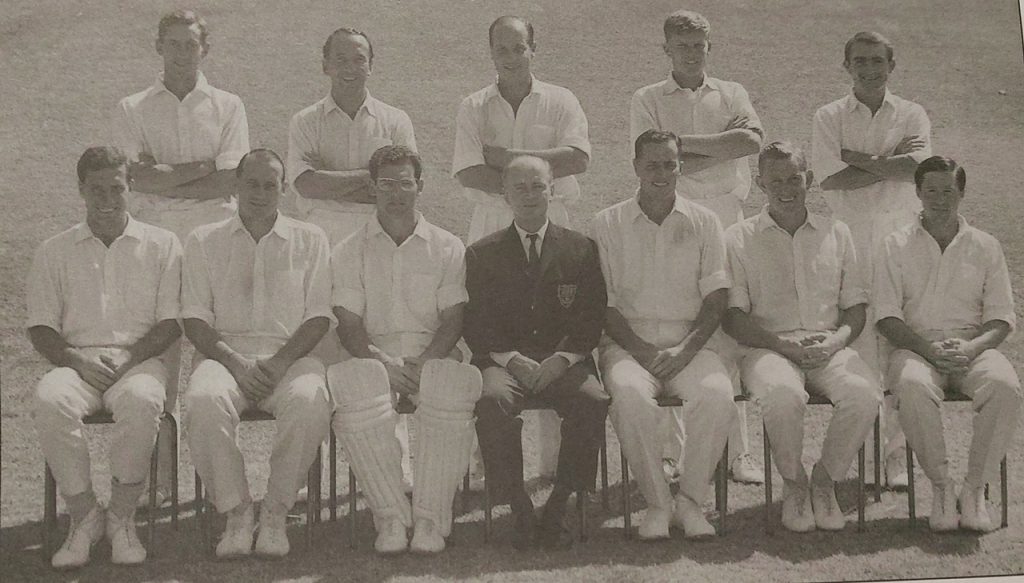
13 May 2020 – It is a remarkable photo: a collection of supreme cricket talent, all from Durban High School (DHS). Within the photo, taken on the occasion of the centenary of DHS in 1966, are eight test cricketers and three provincial players, writes KZN10.com’s Brad Morgan.
(In photo: back row, left to right: Grayson Heath, Jack Kaplan, Peter Dodds, Barry Richards, Lee Irvine.
Front row, left to right: Richard Dumbrill, Hugh Tayfield, Dennis Gamsy, Leslie Theobald, Trevor Goddard, Geoff Griffin, Colin Wesley)
At the time, the Springboks were one of the leading cricket teams in the world, soon to become recognised as the best, before South Africa was shut out of test cricket from 1971 to 1992 due to the apartheid policies of the country’s government.
Pride of place in terms of achievements from that team must go to Barry Richards, who was 21 at the time of the centenary match.
He played only four test matches in 1970, but went on to make such an impact with Natal, Hampshire and South Australia, with other stints at Gloucestershire and Transvaal too, that Sir Donald Bradman, he of the 99.94 test batting average, named Richards in his Dream XI in 2001. Bradman chose his side from a pool of 69 players and excluded, among others, Brian Lara, Viv Richards and fellow South African, Graeme Pollock. That’s a remarkable statement from the man regarded as the greatest batsman to have played the game.
In late 1970, playing for South Australia against Western Australia, Richards struck an unbeaten 325 runs on the opening day of the four-day Sheffield Shield clash, played on the WACA, which was notorious for its pace.
The Western Australia attack included Graeme McKenzie, who opened for Australia; the great Dennis Lillee who would make his test debut a couple of months later; leg-break bowler, Tony Mann, who played test cricket for Australia; slow left-armer, Tony Lock, who appeared in 49 tests for England; and Aussie international Jon Inverarity. Ian Brayshaw was the sixth bowler in the innings and the only one of them not to appear for his country.
Richards’ stunning innings was for many years the most runs scored by a batsman in first class cricket. It was finally beaten by Brian Lara in 1994, when he made 390 runs against Durham for Warwickshire. Durham had no international bowlers at the time. In fact, they had begun playing first class cricket only two years earlier.
Richards went on to tally 356, out LBW to Mann on a ball that the bowler admitted pitched on leg stump and was a wrong ‘un, set to turn further down the leg.
Hill Premium Quality Cricket Balls stay the distance. www.hillcricketballs.co.za
During his career, Richards totalled 28 358 runs at 54.74, with 80 centuries. In his only test series, the famous 4-0 whitewash of Australia in South Africa, he scored 508 runs at 72.57. His performances were highlighted by a remarkable stand with Graeme Pollock – in the second test in Durban, appropriately – during which he reached 94 by lunch before going on to make 140, while he and Pollock flayed the Australian attack to all corners of Kingsmead, putting on 103 in an hour.
In 1969, he was named one of Wisden’s Cricketers of the Year. In their article, Wisden notes: “Richards recognises his debt to Butler, to Wilf Isaacs, who is always ready and keen to help cricket and cricketers in South Africa, and to Leslie Theobald, his cricket master at Durban High School.”
“When Richards captained the South African Schools side in England in 1963, Mr. Theobald was manager, and their partnership produced outstanding results.”
The article concluded: “Richards’ horizons seem limitless, and it will be fascinating to see how far his talents will take him. Few, anywhere in the world, have his possibilities.”
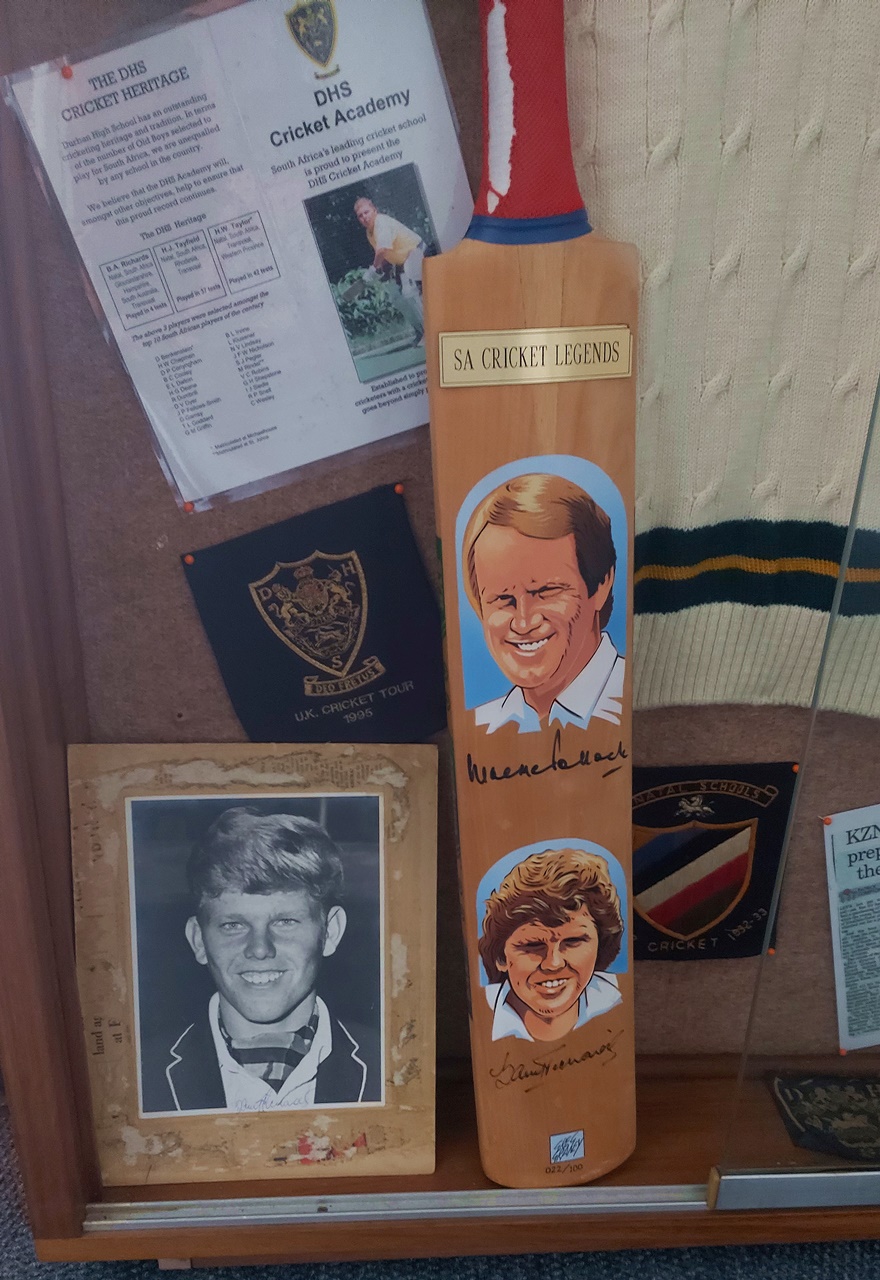
A photo of Barry Richards in his DHS honours’ blazer alongside a bat signed by Richards and Graeme Pollock.
Lee Irvine, a year older than Richards, also played just four tests in 1970 against Australia. Like Richards, he also excelled. He scored 353 runs at 50.42, including 102 in his final test innings on his 26th birthday.
He played 157 first class matches, for Natal, Essex and Transvaal, tallying 9 919 runs at 40.48, with 21 centuries. It should be mentioned that in those days pitches were tailored to a more equal battle between bat and ball. Nowadays the balance has tilted in favour of batsmen with television’s focus on providing entertainment. Thus, an average of 40, which is very good, would, arguably, have been closer to 50 in today’s conditions.
Ali Bacher, the captain of the 1970 Springboks, once called Irvine the most under-rated batsman in South Africa. “He seemed always to live in the shadows of Barry Richards and Graeme Pollock. What I saw of him during the five-year period we played together, he was certainly in their league,” he said in a newspaper report in The Citizen in 2014.
Interestingly, Irvine and Richards played together for two years at DHS – Richards was a year younger – and Irvine, in his matric year, performed better than Richards managed in any of his three years in the 1st XI, scoring 1 310 runs at an average of 68.95.
Check out the Cell C personal and business contracts at https://www.cellc.co.za/cellc/contracts
“There was no question he was a world class batsman. He was light on his feet, had terrific footwork and he was a beautiful timer of the ball, very similar to AB de Villiers,” Bacher said.
Leading cricket commentator Mark Nicholas compared Irvine, a wicket-keeper, to Australian Adam Gilchrist, high praise indeed.
After his playing days were over, Irvine became a familiar voice to radio listeners and television viewers of cricket.
As if two world class talents were not enough in the centenary match of 1966, there was a third: off-spin bowler Hugh Tayfield. For many years, he was South Africa’s leading test wicket-taker and in 1956 he was named one of Wisden’s Cricketers of the Year.

DHS old boys: Jon “Pom Pom” Fellows-Smith, Geoff Griffin, Colin Wesley, Trevor Goddard and Hugh Tayfield. all members of the South African national team that toured England in 1960.
In an article about his selection, the publication wrote: “In the seventeen Tests played by South Africa from 1952 to the end of the 1955 tour of England, J. E. Cheetham’s spin bowlers accounted for 109 batsmen. Of these, no fewer than 87 fell to the guileful, tenacious Tayfield, an average of four out of every five.”
It also recognised the development of Tayfield at DHS: “As a boy, Hugh bowled out of the back of his hand and though his batting and fielding were sufficient to keep him in the Durban High School XI his opportunities with the ball were limited. The turning-point in Tayfield’s career occurred when the school captain, also a leg-break bowler, suggested that Tayfield should try his hand at off-breaks.
“At his first attempt Hugh took two or three good wickets and promptly resolved to concentrate on his new-found art. Tayfield cannot recall being coached or modelling his technique on that of any other bowler, but he progressed so rapidly that soon after his seventeenth birthday he made his first-class debut for Natal. The following season, 1946-47, he helped Natal to win the revived Currie Cup competition and attracted special attention by taking six for 27 and six for 46 in friendly matches against Rhodesia and Transvaal respectively.”
When the match is tight and every run counts, you can count of Clox Scoreboards of KZN. http://clox.co.za/
The 13 for 165 he took against Australia in Melbourne in 1956 remains the third best test return ever by a South African bowler and he, alone, is the only South African to take 13 wickets in a test twice. His 9 for 113 in England’s second innings in Johannesburg in 1957 is the best return in an innings by a South African, and it also saw the Springboks to a narrow 17-run victory.
Tayfield’s test career spanned 11 years – from 1949 to 1960 – and 37 test matches (South Africa played only England, Australia and New Zealand in those days), during which he took 170 wickets. His obituary in Wisden in 1994 noted that he took more wickets per test than Jim Laker (he of the famous 19 for 90 against Australia in 1956) and more, too, than the great West Indian, Lance Gibbs.
Tayfield also holds the test record of sending down 137 balls without conceding a run against England in Durban in 1957.
He played in 187 first class matches, capturing 864 wickets at just 21.86 per wicket. His test economy rate was just 1.94 runs per over and his first class economy rate of 2.06 was very slightly higher.
He also scored 862 runs in tests and 3 668 in first class cricket, with a best of 75 in tests and 77 in first class games.
To this day, Hugh Tayfield remains, comfortably, the leading test wicket-taker all-time among South African spinners.

Trevor Goddard, a left-handed all-rounder, was also part of the legendary Springbok side of 1970. But he enjoyed a much longer test career, having played for South Africa for the first time in 1955.
He played 41 test matches, scoring 2 516 runs at an average of 34.46. A century, though, eluded him until his 62nd innings, when he scored 112 in the second innings of the fourth test against England in Johannesburg in 1965, having made 60 before being run out in the first.
Goddard also captured 123 wickets at 26.22. He gave little away with the ball and his economy rate of just 1.64 runs per over is the best in test history for bowlers taking 30 or more wickets.
He is also part of a small, select group of players who have opened both the batting and bowling in the same test for their country. Interestingly, one of the other South Africans to have achieved the feat was Herbie Taylor, who did it twice in 1914 against England. Taylor also attended DHS and, like Barry Richards and Hugh Tayfield, was named one of Wisden’s Cricketers of the Year, with his recognition coming in 1925.
According to Sir Donald Bradman, Goddard was “a very fine cricketer”.
Goddard played 179 first class matches, scoring 11 289 at 40.60, including 26 centuries, and took 534 wickets at 21.65.
Geoff Griffin is an interesting name among these great DHS old boys and cricketers. He played only two test matches, but he achieved a first by a South African, which can never be taken away from him
In the second test of South Africa’s tour of England in 1960, Griffin claimed a hat-trick, removing MJK Smith, Peter Walker and Fred Trueman. Not only does his hat-trick remain the only instance of a South African taking a test hat-trick, it is also the only instance of it occurring at Lords, the home of cricket.
Unfortunately, he was also no-balled in that test on a number of occasions for throwing. His throwing issues stemmed from an accident when he was in school which left him unable to fully straighten his arm. The no ball calls led to Griffin, remarkably, claiming a hat-trick in his second and last test.
Sadly the throwing problem was never resolved and Geoff Griffin’s first class career came to an end at the age of only 23. He captured 108 wickets at 21.61 and scored 895 runs at 17.90.
It is a credit to Griffin’s character that when a lawyer offered to represent him in court on the subject of his action, Griffin, as reported by Cricinfo in his obituary, declined as he did not wish “to sully the great game further”.
A remarkably talented all-round sportsman, he won Natal schools’ titles in long jump, high jump, triple jump and the pole vault. He also played hockey for Rhodesia.
Pivotal Talent’s Online SubjectChoice (Grade 9s) and CareerGuide (Grade 10s, 11s and 12s) solutions replaces uncertainty with accuracy in directing your children to make full use of their potential. Check out www.careerguidesolution.co.za
Wicketkeeper Dennis Gamsy was another member of the 1970 South African team, who played in the first two tests before making way for the experienced Denis Lindsay, the hero of the 1966/67 series against Australia.
Easily recognised by his distinctive glasses, Gamsy also played 93 first class matches for Natal, scoring 3 106 runs at 23.70, with a batting best of 137. He took 278 catches and effected 33 stumpings.
Richard Dumbrill also donned the green cap of the Springboks, playing in five tests in the mid-sixties. In fact, his last test, against Australia, started on 31 December 1966 at Newlands, therefore in the centenary of DHS.
His first test, a draw against England at Lords in July 1965, was his most successful. He took 3 for 31 in 24 overs in England’s first innings and followed up with 4 for 30 in 18 overs in the second to finish with match figures of 7 for 61.
Dumbrill’s first class career lasted 51 matches. In that time he tallied 1 761 runs at 23.48 and claimed 132 wickets at 22.03, with a best return of 5 for 34.
A sticky wicket makes for messy backyard cricket. Take action before it’s too late. www.midlandssepticservices.co.za
Colin “Tich” Wesley was selected for three tests during South Africa’s 1960 tour of England. Like Dumbrill, he played just 51 first class games. He scored 1 892 runs at 27.02, including three centuries, with a high score of 131.
A part-time bowler, Wesley picked up 15 wickets at a healthy average of 23.60, conceding 2.31 runs per over.
The remaining three players in the photo all played provincial cricket. Grayson Heath turned out in 46 first class matches, scoring 2 029 runs at 31.21, with a top score of 159 not out. He also claimed 36 wickets at 29.08.
Importantly, he also oversaw the merger of DHS Old Boys and the Pirates Kismet Cricket Club at a time when the DHSOB club, previously home to a long list of top cricket stars, went through a downswing. Today, that club is the DHS Rhythm Cricket Club.
Peter Dodds turned out for both Natal and Transvaal. A slow left-armer, he took 120 wickets in 39 first class games at 29.07, including a best of 7 for 51.
Jack Kaplan, a right-hand batsman and wicketkeeper, played in eight first class matches between the 1948/49 and 1951/52 seasons. He batted only 11 times, recording a high score of 62. He also bagged 15 catches and a remarkably high eight stumpings.

When it comes to a great getaway look no further than the five star Fordoun Hotel Spa and Restaurant in the leafy peace and quiet of Nottingham Road. Use Fordoun as your base to explore the delights of the KZN midlands. Go to https://www.fordoun.com/
About the centenary match, which was played at the DHS Old Boys’ Club: It was a two-day, two-innings, contest between the DHSOB XI and a Natal XI.
The Rest of Natal XI featured four Springboks: captain Jackie McGlew, Peter Carlstein, Mike Proctor and Pat Trimborn. It also featured another two DHS old boys, namely Charles Sullivan and Peter Marais.
In the game, Richard Dumbrill struck 114 and shared a partnership of 127 with Lee Irvine in the DHSOB XI’s first innings, but they found themselves trailing by 64 runs. The Old Boys were subsequently set a target of 188 runs to win in two-and-a-half hours and managed it in just an hour and 47 minutes for the loss of seven wickets to claim a three-wicket victory.
To this day, no school has produced as many South African test cricketers as Durban High School.
DHS come up just short as Northwood take tight victory
https://kzn10.com/dhs-come-up-just-short-as-northwood-take-tight-victory/
Captain Matkovich guides Westville to win at DHS
https://kzn10.com/captain-matkovich-guides-westville-to-win-at-dhs/
Thoughts on a lost season: Westville hockey star Ethan Matkovich
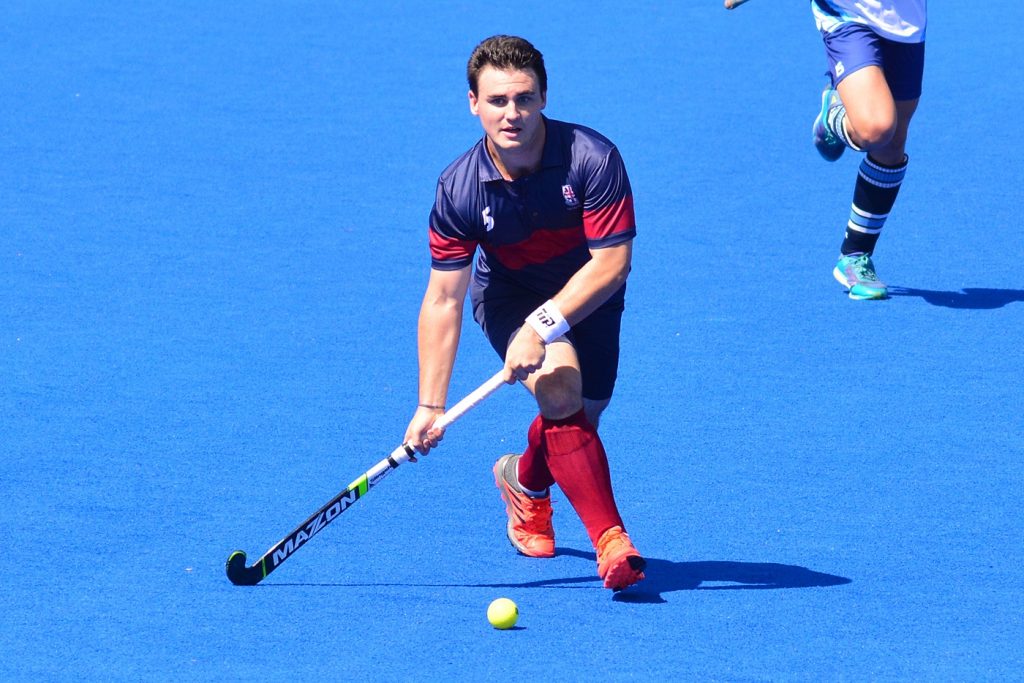
8 May 2020 – The Covid-19 lockdown has been a shocking blow from the viewpoint of winter sports in schools, especially for learners in matric, set for one last hurrah, as the stars of their various teams, writes KZN10.com’s Brad Morgan. For Westville Boys’ High hockey captain, Ethan Matkovich, it’s meant missing out on an opportunity to follow up on a brilliant 2019 season, both individually and from the standpoint of the side.
Last year, Westville went undefeated, beating some of the top teams in the country, including Jeppe, whom many had considered to be number one before they met the KZN side, giving Westville a legitimate claim to the top spot.
Although he was in grade 11 at the time, Ethan was one of the key players in the Westville line-up, which was reflected in his selection for the KZN Coastal team and then the SA under-18 hockey squad.
Just before the lockdown began, that achievement was recognised when Ethan received his merit tie [a level above an honours’ award, given to boys who receive national honours] from Westville, along with Luke James (SA gymnastics) and Troy Botha (SA softball).
Westville vs Kearsney match report 2019
https://kzn10.com/westville-boys-vs-kearsney-college-hockey-match-report/
Westville vs Hilton match report 2019
https://kzn10.com/kzn-school-hockey-match-report-hilton-college-vs-westville/
When the match is tight and every run counts, you can count of Clox Scoreboards of KZN. http://clox.co.za/
There was uncertainty when schools closed early as to what it would mean for the winter sports’ season. Now, sadly, it has become clear: all schools’ hockey and rugby matches and inter-provincial tournaments have been cancelled.
“It is obviously something no one expected, or even thought this could ever happen. It is really tough,” Ethan said on Thursday.
“I think of all the build-up that we did, and all the training from last year that we haven’t been able to use. It’s a big shock for everybody. I was certainly expecting a lot of big things this year. Unfortunately it didn’t pan out and we’ve just got to try and find a way forward.”
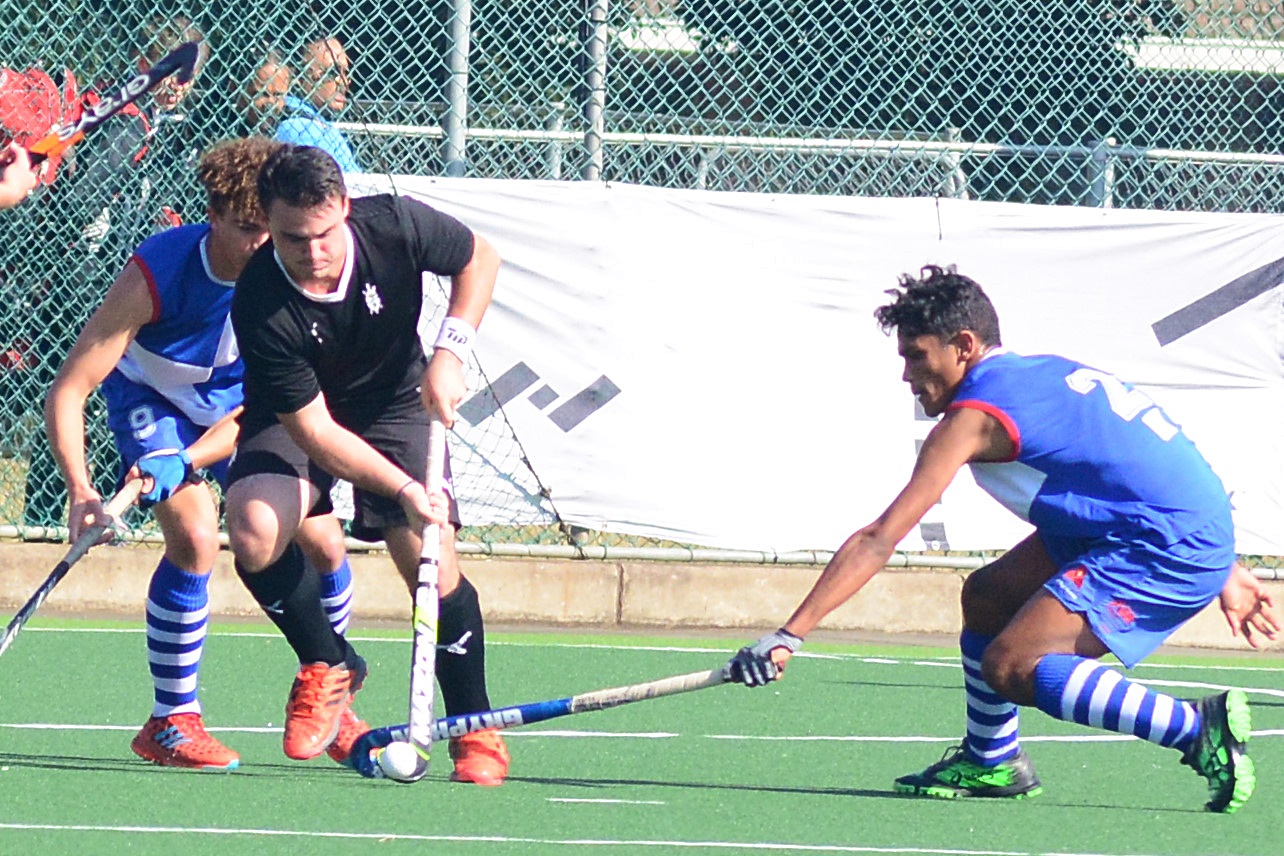
Cleaning things up at the back, Westville hockey captain and centre half, Ethan Matkovich.
“It has been quite frustrating,” Director of Hockey, Cameron Mackay, said in a phone call. “I think it is more frustrating for the boys, especially for the matric boys who have gone through five years, always waiting for their matric year.
“Hopefully we can do something for the boys before the end of the year. It has been frustrating to be unable to do anything. I like to get onto the turf as much as possible, so it’s been tough.”
“There’s a couple of guys who have been in the system for a number of years. Keegan McCallum was injured last year, so he didn’t get to IPT, so this was his year to make up for that, but it’s tough because the guys have worked hard to get fit and get to where they are.”
Hill Premium Quality Cricket Balls give you bounce for your buck. Contact Stuart at stuart.hill@hflgroup.co.z to find out more about his value-for-money product range.
hillcricketballs.co.za/
There were many fans of hockey who were looking forward to seeing Westville in action this season, and they were not just supporters of the school. After their outstanding exploits of 2019, many wanted to see what kind of follow-up Westville would produce.
Mackay explained the make-up of the 2020 team: “We lost quite a few matrics from last year, but we still had Ethan. Our back four and goalkeeper were all gone, except for Ethan, then we kept two of our three starting midfielders, and we still had half of the forwards. We lost quite a few guys, but the grade tens coming through are quite decent as well. We had a good side for this year.”
It is worth noting the strength in midfield and up front because if there is one shortcoming in South African hockey, generally speaking, it is finishing. Then, having a general at the back, controlling matters, like Ethan Matkovich, goes a long way to providing a reliable and effective defensive unit.
“We have always had a philosophy at Westville of managing our back four the best we possibly can,” Mackay said, “and creating that platform first and then going forward from there. It’s been a good system in the last few years.

Always calm and composed, and a leader, Ethan Matkovich.
“A guy like Ethan is a blessing. He is just so controlled at the back. He controls the tempo of the game and he has a really good head on his shoulders.
“He keeps it simple and does the simple stuff better than anyone else, which is quite a strange thing to see in schoolboy hockey. You look for that at under-21 level, sometimes not even then. He has the maturity of a man at the back, which is cool.”
For Ethan, it is about leadership. He’s been a captain throughout his school career, in every team he has played in, excepting when he made teams as a player a year younger than the other boys.
Attention to detail separates the best from the rest. Talk to the experts. http://www.hilliarandgray.co.za/contact/
Captaincy has always been a positive force in his sporting achievements, he said: I think it helps my game. It gives me more responsibility, which means I can’t lower my standards. I enjoy it.”
Like Westville’s approach to hockey, his leadership style is not flashy, it’s more of a blue-collar thing, getting down to work and setting the example. The word that keeps coming up is “simple”.
“We just have to keep things simple. The simple things are most often the things that win you games. Always work hard. You can’t beat hard work.
“We know, as Westville, we don’t have those flashy players and the ‘best players’, but we, as a team, will work harder than anyone else. We’re happy to play our way and do the hard work. If we win by one or we win by 10, we’re still winning the game.”
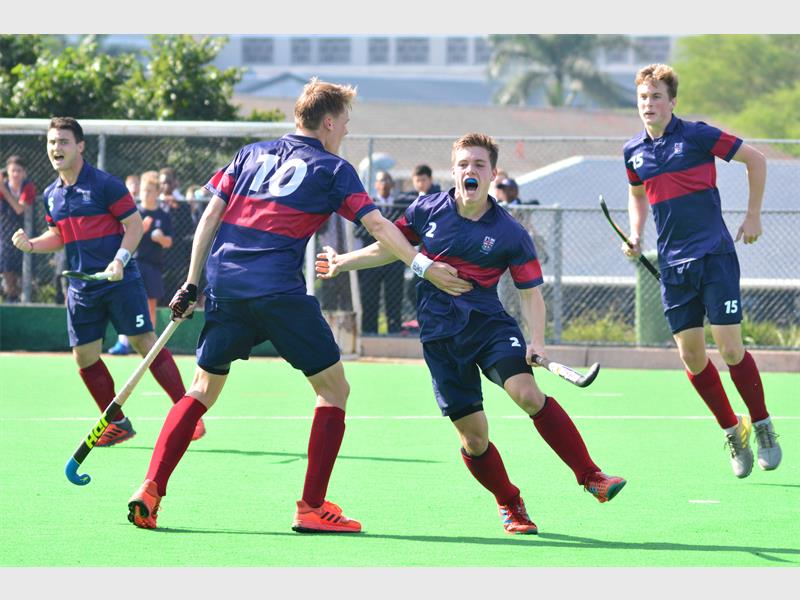
The Westville 1st XI of 2019 celebrate an undefeated season after a 3-1 victory over Kearsney College. Ethan Matkovich is on the left. (Photo: Highway Mail, https://highwaymail.co.za/)
That outlook is reflected in coach Cameron Mackay’s overall programme for Westville hockey. “We’ve set quite a good platform for ourselves where the kids are learning the same thing from grade eight,” he said.
“We might not always get the best kids [talent] in the province. We get a good type of kid, hard workers. We get good hockey players, too. But then you also have good cricketers who are good at hockey, and good soccer players who are good at hockey.”
“We have good depth, and we end up with kids who maybe didn’t come to Westville as hockey players, but they end up loving the sport.
“We set out a programme a few years ago – Sharmin Naidoo and I – where we put together a full programme that we wanted the boys to learn from under-14 to under-18, so all of our coaches spoke the same language. We kept it as simple as possible and we tried to make the philosophy that we will just do the basics better than anyone else, as opposed to trying to be really flamboyant and doing different things while allowing our coaches to do their own thing. I think that has been our biggest strength.”
 In action in the famous black and white of the KwaZulu-Natal Coastal team.
It’s a no-frills approach, but it works very well. Ethan said: “Hard work is key. We hear from other players, at provincial tournaments, or at provincial training, they say they are a little intimidated to play us. Not because of the fancy stuff we do, but because we are always pressing and coming at them hard. I think that is shown in all aspects of the school. In academics, we generally have people in the top 10 percent of the province. In all sports, we generally have a group of boys performing at the top provincial level.”
As far as hockey is concerned, since Ethan has been at Westville Boys’ High (having attended Westville Pre-Primary, Westville Junior Primary, and Westville Senior Primary) the school has always been a top 10 team in South Africa. While he might not have the opportunity to continue that superb record this season with the school, there is at least some light on the hockey horizon for him.
Ethan is a member of the national under-18 squad and had been set to play for the side at the under-21 Inter-Provincial Tournament (IPT) this year. That opportunity has passed, but there is still a big event set for next year.
“We received an email the other day [from the South African Hockey Association], saying that for the under-18 squad they’re going to try and create contact time between the squad and the staff of those groups. They’ll try and do some video calls and mental training, speaking about a way forward.
“The Junior World Cup happens at the end of next year and hopefully a few of us will be able to go on that tour. They’re trying to be proactive, to connect with us, and making sure we’re okay. I assume they’re going to be doing this soon and showing us a way forward.”
When it comes to planning your next school sports tour look no further than former Hilton College first XI captain Craig Goodenough who’s been there, seen the movie and bought the T-shirt factory.
The Westville hockey team, meanwhile, has not been idle. “We are trying to stay positive as a group,” Ethan said. “We are doing some fitness challenges and posting them on our WhatsApp group. Obviously everyone is hurting from this.
“We do simple stuff, like seeing how many push-ups you can do in a certain amount of time, a few silly things like that to keep us going.”
Besides being an outstanding hockey player, Ethan is also a top cricketer and has received his provincial colours in the sport. He is, naturally, captain of Westville, a player with a good head on his shoulders, and a composed batsman who plays with enviable fluency.
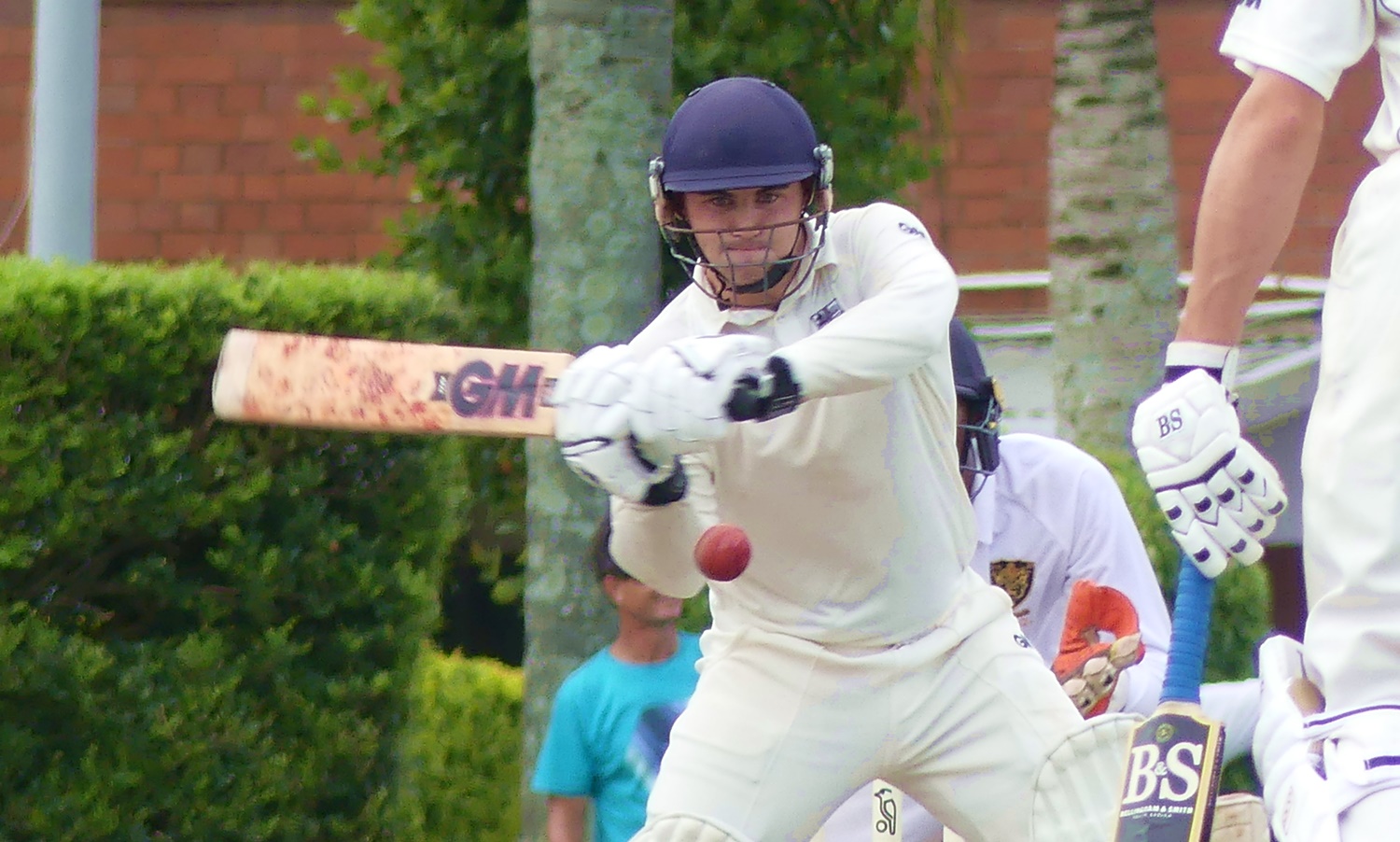
Ethan Matkovich on his way to an unbeaten fifty, which saw Westville to a hard-fought victory over DHS in the first term. (Photo: Brad Morgan)
The first term, he admitted, was an up and down time for the 1st XI, a very talented side on paper which, too often, found different players firing at different times and seldom together. In some games the bowling was on song, in others it was the batting, but, as happens in cricket, form can be a fleeting thing and the margins between winning and losing can be extremely fine.
Ethan was at his unruffled best in a win over DHS, leading his team from 50 for 5, chasing 146 to win, to victory without the loss of another wicket on a pitch that had some turn and an outfield that was very heavy, a fact that was reflected in the DHS innings which produced only two fours.
“We had a really good side on paper, but we battled to win the key moments in games,” Ethan said. But, with only four matric boys in the line-up, Westville was always a competitive team, which suggests good things are on the horizon, with lessons learnt from a challenging season set to become valuable assets. And the example set by the skipper is one of the biggest among them.
One thing that one can be pretty sure about, Ethan Matkovich will continue to lead, in good times, in bad times, when challenges are fun, when challenges are daunting, even in this unprecedented time. With that approach, whether the hockey season or any semblance of one happens this year, it is surely not the last we will hear about his sporting exploits.
Michaelhouse ’86: a loaded team, quarantine and the first overseas tour

With Covid-19 having wreaked havoc with sport all around the world, including, of course, the schools’ rugby season, we’re taking a look back at some past teams and, on this occasion, we’ll focus mostly on the Michaelhouse 1st XV of 1986, which also had its own issues with quarantine. The side’s captain, Bruce Herbert, chatted with KZN10.com’s Brad Morgan.
Shortly after the start of the 1986 season, an outbreak of hepatitis saw the Michaelhouse 1st XV quarantined to the school sanatorium for three weeks, (the rest of the school continued to function normally) undermining the form of a very talented side, which produced five Natal Schools’ players, including Bruce Herbert (prop), Philip King (hooker), John Pool (lock), Richard Firth (flank) and Murray Collins (scrumhalf). That was, at the time, a Michaelhouse record.
Bruce started in the 1st XV in 1985, having made the move straight from under-15 A after the departure of Mike Reilly, which opened up a place at tighthead prop. He was still 15 when he made his debut on a pre-season tour to East London against Selborne College. Up against players three or four years older than he was, it was no surprise he termed it “a massive baptism of fire”.
Michaelhouse were captained by Wayne Witherspoon, who was an excellent mentor, said Bruce. He used the lessons he learnt from Wayne when he was appointed captain the following year.
Captain Ben Parham tells how Michaelhouse 1st XV 1996-97 beat Hilton three times in a row

The 1985 Michaelhouse 1st XV, captained by Wayne Witherspoon. Bruce Herbert is directly behind him.
He also mentioned some standout memories of the 1985 season:
Facing Glenwood at Glenwood, ‘House were 3-6 down, but they had a penalty right in front of the uprights to draw level. Victor Anderson, the fullback, who played Natal Schools in both 1985 and 1986, duly slotted the ball between the posts to make it 6-6. But… The referee ruled that Richard Firth had been in front of Anderson and the successful kick was disallowed.
“Richard was next to me and we were definitely behind the kicker,” Bruce reckoned.
There was a late escape against Kearsney in a match played in Botha’s Hill. Down by a few points, Michaelhouse faced a 22m drop out from the home side. The kick didn’t gain much height and lock Sean Stringer plucked it out of the air before racing through to score to win the game for ‘House.
Then there was a game against Maritzburg College, a team that had lowered the colours of Grey College that year in a hugely anticipated showdown. Bruce reflected: “I remember thinking how small the College side looked before we ran on, a schoolboy error. I guess I was expecting much larger guys but, don’t get me wrong, they were tough. The loose head I scrummed against looked like a third year varsity student! Just remember, I was 16 years old.”
When the match is tight and every run counts, you can count of Clox Scoreboards of KZN. http://clox.co.za/
Michaelhouse won the first of the Hilton/Michaelhouse derbies when Victor Anderson scored all of the red and white hoops’ points in the last minutes of the contest. Hilton reversed the result in the second clash, claiming a 12-6 win in an ill-tempered affair.
It was tough for a 16-year-old Bruce Herbert in 1985, but it was excellent preparation for 1986, even though he remained young, turning 17 in April.
To put it into context, Bruce was born in Eshowe hospital on 11 April 1969. Pete Smith, who attended Maritzburg College, was born in the same hospital the day before Bruce. Yet Bruce captained Michaelhouse in 1986 and Pete captained College in 1988, two years later! By then Bruce had played for two years for the Natal and SA Air Force under-20 teams.
Fortunately for Bruce, during his time at Michaelhouse he captained some very strong teams at age group level. He led the under-14 A team in 1983, the under-15 A side in 1984, and then moved up to the 1st XV the following year, culminating in him captaining the team in 1986.
The under-14 A team lost just one match in ’83, going down to DHS away from home, while the under-15 A side fell in their last game of the season only, going down to Hilton at home. “Methinks a bit of complacency crept in,” he ruefully admitted.
Along the way, though, there were wins over the always-strong Maritzburg College at both under-14 A and under-15 A level, as well as victories over the big government schools: Westville, DHS and Glenwood.

The greatest advertisers for the range of Titan Technologies security products is their customers. Phone Mark and Jens at 033 394 3776 or go to http://titantech.co.za/about-us/
Bruce attributed much of that success to the under-14 A coach, Gordon Paterson, who put together five excellent seasons while in charge of the team, with winning percentages of 92% in 1977, 85% in 1978, 100% in 1979, 80% in 1982 and 92% in 1983. He missed out on the 1980 and 1981 seasons because he was busy with his PhD at Stellenbosch University.
So, on to the 1986 1st XV. Statistically, it was the most successful Michaelhouse team of the 1980s, winning 14 and losing five games for a 74 percent winning mark. With four Natal Schools’ players in the pack and the Natal Schools’ scrumhalf, it was a powerhouse up front. But hepatitis likely cost them an even better record.
A win that stood out was a 52-32 defeat of the Old Crocks, who were loaded with former Natal provincial players, including former Springbok eighth-man and Natal skipper Tommy Bedford. That Old Crocks’ team included Tommy Bedford (c), Tim Cocks, Gary Joubert, Laurie Sharp, Tubby Hannaford, Robbie Savage, Garth Giles, Peter Ripley-Evans, Rodger Bond, Brian van Rooyen, Wally Watt, Dave Coleman, Brian van Zyl, Dick Cocks, and Matt Taylor.
A sticky wicket makes for messy backyard cricket. Take action before it’s too late. www.midlandssepticservices.co.za
The clashes with DHS and Marizburg College were undermined by illness. College flyhalf Udo Goedeke, in an interview with KZN10’s Jono Cook in 2018, said Michaelhouse were favourites to win their showdown.
“I think they sensed victory and all their regulars were keen to play. Injury and illness meant quite a few had to pass late fitness tests.
“It was very close at halftime. We led 9-6. The second half was incredible. [SA Schools’ centre] Jeremy Thomson really turned it on for us. It turned into the Jeremy Thomson Show; he ripped their defence apart.
“The College team’s contribution was awesome. It was a massive second half for us. To be fair, I think the Michaelhouse injury and illness concerns pre-game were a contributing factor. They faded badly in that second half.”
The game ended 40-6 in College’s favour, which was testament to just how much the hepatitis had hit ‘House. The following week, the DHS game was a very close affair with the Durbanites edging it 12-10.
When it comes to planning your next school sports tour look no further than former Hilton College first XI captain Craig Goodenough who’s been there, seen the movie and bought the T-shirt factory.
Later in the season, Michaelhouse showed their true colours in a narrow defeat to Bishops at the Private Schools Rugby Festival at Hilton. Bishops were very much the Cape Town equivalent of College in those years and renowned for the flowing, attractive rugby they played under the legendary coach Basil Bey. To put it into perspective, the Bishops’ side was unbeaten in 1986, beating the likes of Paarl Gym, Paarl Boys High and Paul Roos (they didn’t play Grey College), as well as all the Cape’s southern suburbs schools. (SACS, Rondebosch, Wynberg etc.)
“We were unlucky to lose 13-18 to Bishops,” Bruce Herbert said. “We knocked on the ball over their line! As they say, could have, should have, would have.”

The Natal Witness carried a report on the Michaelhouse versus Bishops thriller.
At the same tournament, though, ‘House dominated Saint John’s 22-4 (remember tries were worth four points back then) and Saint Stithian’s 30-3.
They finished their season with narrow wins over Glenwood (18-15) and Hilton (19-17), but went down to Westville (18-29). “Westville had a really good game against us. We hammered them up front. However, they ran us off our feet with some really good speed and handling,” Bruce commented.
It was a remarkably closely contested season among Natal Schools: Michaelhouse beat Hilton twice, Hilton beat College on College Old Boys’ Day, College beat Michaelhouse, Glenwood beat College, College beat Glenwood, Michaelhouse beat Glenwood. The Kearsney vs Michaelhouse game was called off due to the hepatitis quarantine.
Natal Schools
That same year, Natal, coached by Dave Dell, and with six College boys, five from Michaelhouse, three from Westville, two from Hilton, one from Kearsney, one from Estcourt, one from Linpark and one from Glenwood enjoyed a strong showing at the Craven Week in Graaff-Reinet.

Michaelhouse’s Natal Schools’ representatives of 1986 with MHS masters: Bruce Herbert, Philip King, Rich Firth, Mr Gordon Paterson, John Pool, Murray Collins, and Mr Richard Aitchison.
The one player from Kearsney was Nkululeko “Skweegee” Skweyiya, the first ever black player to be selected for the Natal Craven Week team.
They opened their tournament against the always strong Northern Transvaal and after a tremendous tussle came away with a win, which was clinched through a penalty try after a late tackle on Jeremy Thomson. They followed that up with a narrow 4-6 loss to Eastern Province before beating Far North.

The Natal Schools’ team that competed in the 1986 Craven Week in Graaff-Reinet:
Back row: Warren Wilson (Maritzburg College), Richard Firth (Michaelhouse), Richard Dolbey (Maritzburg College), John Pool (Michaelhouse), Sean Platford (Westville), Brenton Catterall (Maritzburg College), Sean Fry (Westville), Trevor Labuschagne (Glenwood).
Middle row: Murray Collins (Michaelhouse), Dallas Harris (Hilton College), Philip King (Michaelhouse), Udo Goedeke (Maritzburg College), Joe Fernandez (Linpark), Nkululeko Skweyiya (Kearsney), Leon van Rooyen (Escourt), Alastair Hawley (Westville).
Front row: Bruce Herbert, Dave Dell (coach), Anthony Gilson (Maritzburg College, captain), L. Kirkland (Manager), Carl Jankowitz, (Hilton College) Rod Blamey (chairman), Jeremy Thomson (Maritzburg College).
Jeremy Thomson and Leon van Rooyen (Estcourt) were selected for the South African Schools team. Bruce shared a story which Jeremy Thomson told him about the SA Schools’ team photo. Back then, of course, there were no digital cameras, so everything was done on film. Imagine the horror felt by the photographer when, after photographing the side for their official team shot, he went to develop the photos and discovered that he had failed to put any film in his camera!
Hilton/Michaelhouse derbies
Unsurprisingly, Bruce has particularly vivid memories of the Hilton vs Michaelhouse derbies in 1985 and 1986. “They were generally where the underdog often pulled off a remarkable win, like was the case in the first match at Michaelhouse in 1985,” he said. “The news coming from Hilton was that they were going to put 50 past us. Hilton had a good team and had had a successful season so far. As things turned out Victor Anderson scored all our points, scoring 13 points in the last eight minutes. I think we won 13-7.
“Etienne De Villiers who had been a teacher/coach at Michaelhouse for 16 years said that in all his time of watching Hilton/Michaelhouse matches this ’85 match was the best one that he had ever seen.”

Hilton wanted pay back and they got it in the rematch at Hilton, winning 12-6. “Both our Natal Schools Players, James Wilson (scrum half) and Victor Anderson (full back), got injured in the first 15 minutes and had to leave the field,” Bruce recalled. “The late tackle on Victor was so late that the video cameras had moved on and didn’t pick it up. James got a finger in his eye. I remember it being an ill-tempered match. I think the ref lost control to some extent. Quite a lot was said about the match for some time.”
In 1986, the first Hilton/Michaelhouse was played in front of television cameras and a massive crowd at Hilton. Bruce recalled: “As the Michaelhouse 1st XV got off the bus I was called to one side and interviewed on TV. My interview was never screened, only [Hilton captain] Dallas Harris’ interview was aired, much to the amusement of my mates and family. I don’t think I spoke clearly enough and/or maybe mumbled too much?
“Anyway, we did the business on the day, winning 9-7. Rowan Varner, the Hilton eighth-man (and SA Schools’ fast bowler) missed a penalty in the last seconds of the match, just skimming the left upright.
When it comes to a great getaway look no further than the five star Fordoun Hotel Spa and Restaurant in the leafy peace and quiet of Nottingham Road. Use Fordoun as your base to explore the delights of the KZN midlands. Go to https://www.fordoun.com/
The second match at Michaelhouse was a particularly memorable clash because of a stunning fightback from the home side. They were 0-14 down at the break (remembering that tries were worth four points at that time) and Hilton had crossed for three tries.
“I gave the team a serious bollocking at half time and to their credit we bounced back, winning 19-17. I think there were plenty Hilton parents and Hilton supporters that struggled to put the corks back into their champagne bottles as the final whistle sounded!” Bruce said. “Mike Jeffery scored two magnificent tries within minutes of each other.”
Sadly, Mike lost his life shortly afterwards in a car crash while travelling to Johannesburg.
RESULTS
Michaelhouse 36-3 Sandringham
Michaelhouse 16-4 Richards Bay
Michaelhouse 37-9 John Ross College
Michaelhouse vs Kearsney College – cancelled
Michaelhouse 29-15 Linpark
Michaelhouse 52-32 Old Crocks
Michaelhouse 22-9 Estcourt
Michaelhouse 18-30 Old Boys
Michaelhouse 40-0 Weston
Michaelhouse 6-40 Maritzburg College
Michaelhouse 10-12 DHS
Michaelhouse 15-0 Voortrekker
Michaelhouse 9-7 Hilton College
Michaelhouse 29-3 Alexandra
Michaelhouse 22-4 Saint John’s College
Michaelhouse 30-3 Saint Stithians College
Michaelhouse 13-18 Bishops
Michaelhouse 18-15 Glenwood
Michaelhouse 16-29 Westville Boys’ High
Michaelhouse 19-17 Hilton College
Played 19, won 14, lost 5
Points for: 437, points against: 250
Overseas Tour
At the end of November, Michaelhouse toured abroad for the first time. With final exams being written at the time, the side was afforded only seven Sundays of practice before their departure. It was a challenge, especially since the South African season had ended some months earlier.
Due to the sporting isolation of South Africa at the time, the team travelled in civvies.

The 1986 Michaelhouse 1st rugby team overseas touring party. Bruce Herbert is front and centre.
They played two matches, beating the Welsh side Pontarddulais 8-6 and then Sherbourne School of Dorset, one of England’s top school teams at that time, which included two England under-19 players in their ranks, 12-8.
But then the Michaelhouse team arrived back at their hotel to discover that the Welsh Rugby Union (WRU) had overruled the Welsh Youth Rugby Union (WYRU) and declared in the press that the tour unacceptable.
The WYRU encouraged ‘House to continue with their tour but, Bruce remarked: “Effectively, we now became a team on the run.”
On 7 December, the match against Haverford West went ahead, but it was undone by the failure of the referee to arrive. A local coach took over the whistle and refereed in his Wellington boots! His blowing left a lot to be desired.
“No matter what we did, we were penalised out of the game and lost 6-8,” Bruce said. That match was followed by “a strange affair”, a 35 minute practice game against Monmouth, a local independent school, which ended with Michaelhouse 8-5 to the good.
It is imperative for coaches to know what works for you. Get in the driving seat with the tried and tested. Contact Trish right now at info@trishsutton.co.za
Next up was a visit to Sophia Gardens for an outing against a Cardiff Invitation XV on 14 December. A strong showing from Michaelhouse produced a good 22-8 victory, which was followed by a splendid function arranged by the hosts.
The next day, though, matters took a turn for the worse. BBC TV arrived at their hotel and asked to speak with the team. They had been advised not to talk to the media because no matter what they said their words would be turned against them. That evening they were on the 18:00 news.
“We became aware of a little red car tailing us when we were travelling in our two minibuses,” Bruce remembered. “Once or twice we were able to give the driver the slip. On one occasion we forced him onto an off ramp that we weren’t taking. As it sped past in its attempt to find an on-ramp, the driver received a wave and a cheer from all of us on the bus. We did not in any way feel threatened as this surveillance was proving to be a nuisance only.”
Questionable refereeing blighted Michaelhouse’s sixth match against a Monmouth Invitation XV, which saw ‘House beaten 12-4; the man who arranged the game also refereed it and had his son playing in the Invitation side.
Eight of the side then headed to Seefeld in Austria for two weeks of skiing, while the rest of the touring party flew back to South Africa from Heathrow.
Bruce Herbert concluded: “In summary, and I quote from Gordon Paterson’s Book, there is Genius in Passion, ‘While we had achieved a number of excellent results, we had not performed consistently to the full potential of the team during the first part of the season. To my mind the hepatitis had been a major factor that caused an early season glitch in our progress. Again, this is typical of life itself and the true test is the capacity to come back when you have been knocked down. I believe that they were revealing the skill, fitness, tenacity and sportsmanship that we wished to see as the example set by the first fifteen.'”
Kearsney’s great 1st XV of 1987

Having recently mentioned Jem Nel in a story on the brilliant 1987 Natal Schools’ cricket team on Facebook (https://www.facebook.com/KZN10com/), KZN10.com’s Brad Morgan decided to also take a look at the Kearsney College 1st XV, captained by Jem, which that same year produced a season for the ages.
In recent times, Kearsney College has produced some exciting and very successful teams. They have also produced standout players; off the top of my head, internationals’ Brad Barritt, Matt Stevens, and the Du Preez brothers, Robert, Jean-Luc and Daniel, come to mind.
But a team that holds a special place in the heart of many in the Kearsney community is the 1st XV of 1987, a side renowned for an attractive and creative 15-man approach to the game.
They played 22 matches, won 18 of them, drew two others and lost to only one other school side, Maritzburg College, which had SA Schools’ flyhalf Udo Goedeke pulling the strings behind a powerhouse pack.
Their only other defeat was by just two points to an Old Crocks team featuring many former Natal players, 26-28. Sadly the Old Crocks no longer exist. Back in the day, they took on many of the top Natal schools and those matches were invariably superb skillful spectacles.
When the match is tight and every run counts, you can count of Clox Scoreboards of KZN. http://clox.co.za/
A year earlier, before the great season of 1987, much was expected of the Kearsney 1st XV of 1986, but the side failed to live up to its potential. In 1987, expectations had been tempered by the slightly disappointing results of the previous year. Jem Nel, then in his third year in the 1st team, said in a recent chat: “I don’t think we were expected to do as well as we did. There was a bit of hype around ’86. When we started in ’87, there was no hype. There were a few guys coming back.”
While Kearsney started out their season with a bang, it ended with a huge loss when Natal Schools’ flanker Mitchell Reed broke an ankle in the last minute of a 34-3 thrashing of Michaelhouse. “I think he was the best schoolboy player I ever played with,” Jem reckoned.
Like Reed, he also earned Natal Schools’ colours. Unfortunately that came only after the Craven Week.
He recalled: “Mike Falkson, my good mate from Westville, got chosen ahead of me. But there was an injury, so I got called up at the last minute.” Mitch Reed and Jem Nel were the only two from Kearsney to make the Natal Schools’ team that year, which is testament to the superb teamwork of the side.
Check out the Cell C personal and business contracts at https://www.cellc.co.za/cellc/contracts
Jem fondly remembers that season-opening win over Michaelhouse: “We hammered them. In my whole school career, that gave me the most satisfaction. That was the best rugby game we ever played. It was our first game of the season at Kearsney. It was brilliant to play, surrounded by the huge trees. It was fantastic.”
And there was always a little extra in it for Jem whenever Kearsney took on Michaelhouse: “You might remember, I didn’t get into Michaelhouse. I was going to go from Clifton [Nottingham Road] to Michaelhouse and I failed the entrance exam,” he laughed.
“I played sport against Michaelhouse for five years in cricket and rugby and I never lost to them, which was quite satisfying.”
Having mentioned Clifton, there was a remarkable occurrence in 1987, which Jem pointed out, and it’s something that one wonders whether or not it has happened before or since. He explained: “In 1987, the captain of Hilton was Rory Dyer and the captain of Michaelhouse was Bruce Herbert. I was captain of Kearsney. All three of us were from Clifton.” (Bruce has since pointed out that he was, in fact, captain of Michaelhouse in 1986. I attended Clifton at the same time as those guys and was there from 1978 to 1983. When I started there were 120 boys in the school and when I finished there were 150, so an incredible achievement from a very small school, nonetheless).

The author of this story, Brad Morgan (front left), next to Jem Nel (second from left), with 1987 Hilton College captain Rory Dyer to the right of teacher John Farren. Craig Hanbury-King, who played in the Kearsney 1st XV of 1987, is featured second from left in the middle row. Bruce Herbert, the 1986 Michaelhouse captain, is third from the left in the third row.
The two draws – 13-13 against a Westville team that included SA Schools’ player Errol Stewart and 6-6 against Hilton – were very different games, Jem shared.
“We played Westville at Westville on Bowden’s. I think we were a better team than them, but they gave us a hard time. I think it was a lucky draw for us. We scored a try and I think there were about 13 bodies under the ball!
“The other draw was against Hilton, where we played poorly. All they did all day was kick the ball on our fullback and wing. They kicked up-and-unders all day and it was a terrible game. That wasn’t a great draw, but I think the Westville draw was a great draw, because I don’t think we deserved it,” he said candidly.
Back then, Kearsney had only about 530 pupils, but they defeated all the big government schools, apart from Maritzburg College and Westville. There were some tight games among them. They won 15-7 against DHS and 9-8 against Glenwood.

Vision is the hallmark of exceptional leaders. Make an appointment. http://www.hilliarandgray.co.za/contact/
A tour to Johannesburg included two big wins – 34-0 against Highlands North and 56-3 against Parktown, but King David (Linksfield) pushed Kearsney all the way, with the boys from Botha’s Hill pulling out a narrow 3-0 victory.
The 1987 team was coached by Fred Cocks, who served the school with distinction for 39 years. “Freddie was probably about seven years into the [1st XV] job by the time he got to ’87,” Jem said.
“He and his brother went to Westville Boys’ High. He was a brilliant coach. He was a short man, about five-foot, six, and he had this big voice. He was a fantastic motivator and he knew a lot about the game.”
“I remember clearly he called a Kearsney Old Boy, Wally Watt, who was a Natal flanker, to come and help us with one or two scrumming sessions. He was a fantastic man and he is still around.”
There was only one match in which Kearsney were clearly beaten up front and that was in the big showdown with Maritzburg College. “It was played at Kearsney and there must have been 15 000 to 20 000 people there that day, because they were the only two teams that were unbeaten in the season, and it was quite late in the season,” Jem recalled.
“The score was 20-10. I think we turned at 10-10 at halftime, and then we got pummelled by their forwards in the second half. Their forward pack just destroyed us. I think we did well to be in the game at halftime. They killed us up front.” Of course, back in those days, there was no limit on how far one team was allowed to push another at scrum time in schoolboy rugby, so it was a far bigger disadvantage than it would be nowadays.
Take a 5-star break from life in the fast lane. Contact Fordoun CEO and former Michaelhouse rugby star Richard Bates for your well-earned break. https://www.fordoun.com/
“The ’87 side was a fantastic team. I say without a shadow of a doubt, we had the best loose trio. We had Mitchell Reed, who we lost after the first game,” Jem continued. “Then we had Chris van Noordwyk [who went on to play SA Schools cricket in 1989). He filled in there. And we had a farmer from the north coast called Craig Hanbury-King. He was brilliant. He was small and an excellent fetcher.
“Our Head Boy Graeme Thompson was at lock. He was a big guy and we had another water-polo player at lock, Steve Garreau. We had a decent pack up until the time we met College and we were annihilated.”
The ’87 team also included Nkululeko Skweyiya, better known as “Squeegee”, who had burst onto the scene in 1986. That year, playing on the wing, he scored 22 tries and represented Natal Schools.
“He came from the Eastern Cape and he was a stalwart. He had a side-step and speed that nobody in Natal had,” Jem said. “I think in ’87, he sort of got worked out. We moved him closer to the ball, so he ended up playing most of the time at centre. To our advantage, everyone was focused on him and we had other good players.” The team benefitted, but Squeegee didn’t have as good a year as in ’86 and missed out on Natal Schools’ selection.
Get a firmer grip on your possessions with KZN’s Titan Technologies. https://www.titantech.co.za/
Mitch Reed, Jem Nel and Nkuleleko Skweyiya were awarded their honours, while Greg James, Pierre du Toit, Kenneth Everett, Stephen Garreau, Craig Hanbury-King, Stuart Hulley, John Leach, Craig Symons Graeme Thompson and Ross Wood received their colours.
Fred Cocks’ 1st team report in the Kearsney magazine noted of Jem Nel: “The success of the side can largely be attributed to his exceptional captaincy. His ability to motivate his fellow players was indeed of the highest order of leadership. His skilful and creative play saw him narrowly miss selection for the Natal Schools Craven Week team, but deservedly gained him a cap in Pretoria.
“In addition, he was one of three players who scored 11 tries*, the most by an individual. Congratulations on a great season.”
*(The others were scrum-half Pierre du Toit and Craig Symons. Mitch Reed dotted down seven times in only seven matches.)
Reed was clearly an extraordinary talent, as described by Fred Cocks in his report: “One of the best rugby players seen at Kearsney for many years. His strength, skill and mental attitude to the game is exceptional.”

Septic tank & sludge pit drainage? Why let the conditions drain you? DHS Old Boy John Smithers has got your back. email johnsmithers@vodamail.com.
Rugby is one of the great team games, especially when it comes to team spirit and off the field relationships, and to this day Jem still keeps in touch with eight or nine of the 1st XV of 1987: “We’ve got a WhatsApp group, so we’re in contact regularly, especially over lockdown now,” he reckoned.
He lives close to Kearsney and his son, Cameron, completed grade 12 at the school in 2019. Even though the ties are not as close as they once were when Cam was in school, Jem still maintains close contact with Kearsney.
“I watch a lot of sport,” he concluded. “When there’s cricket or rugby on, I love it. If I have nothing on, I go and watch. It’s close and close to my heart. We’ve had good times at Kearsney. I think the emotion of winning is gone, but it’s good to go and watch schoolboy sport.”
RESULTS
Easter Tour of East Griqualand, Natal Midlands
Kearsney 40-0 Port Shepstone
Kearsney 33-0 Ixopo
Kearsney 50-6 Escourt
July Tour to Johannesburg
Kearsney 34-0 Highlands North
Kearsney 56-3 Parktown
Kearsney 3-0 King David (Linksfield)
Natal Fixtures
Kearsney 34-3 Michaelhouse
Kearsney 15-7 DHS
Kearsney 24-3 Pinetown
Kearsney 6-6 Hilton
Kearsney 27-6 Beachwood
Kearsney 26-28 Old Crocks
Kearsney 9-8 Glenwood
Kearsney 10-20 Maritzburg College
Kearsney 31-9 Port Natal
Kearsney 13-13 Westville
Kearsney 25-9 Kingswood
Kearsney 40-0 Saint Charles
Kearsney 20-7 Alexandra
Kearsney 31-18 Old Boys
Played 22, won 18, lost two, drew two
Points for: 554, points against: 155
Kearsney, Northwood share spoils in cracking season-opener
https://kzn10.com/kearsney-northwood-share-spoils-in-cracking-season-opener/
2019: Just four points separated Kearsney and DHS
https://kzn10.com/just-4-points-separated-kearsney-and-dhs/
2019: Kearsney Festival day three
https://kzn10.com/boss-rugga-the-glenwood-green-machine-continue-styling/
2019: Kearsney Festival day two
https://kzn10.com/kearsney-easter-rugby-fest-marquee-day-2-match-cut-short-by-lightning/
2019: Kearsney Festival day one
https://kzn10.com/kearsney-college-easter-rugby-fest-day-1-glenwood-top-the-kzn10-charts/
Luke James is aiming for gymnastics’ biggest stages

Luke James has gone and is going places in gymnastics. He’s one of three Westville Boys’ High learners who were recently awarded their Merit ties, for receiving South African colours in sport. He’s won in national and international competition and he hopes to make it to the Olympic Games, maybe this year in Tokyo or in 2024 in Paris.
Qualifying for this year’s Games has had a spanner thrown in the works with the complications caused by the coronavirus. The African Championships, which also serve as Olympic qualifiers, were supposed to have been held in Eldoraigne from 1 to 5 April.
It’s a temporary setback for Luke, who recently broke into the senior ranks with the national team as the only team member from KwaZulu-Natal.
“Trials are still going to happen, but they’re postponed,” he said in a recent chat with KZN10.com’s Brad Morgan at Westville Boys’ High. “In a worst case scenario, no spectators will be allowed and they’ll have separate days for the different apparatus to keep it under 100 people in attendance. An Olympic trial has to happen regardless of whether or not the African Championships happen.
“I was looking forward to competing in Joburg because of the home crowd. We would have had big support in a nice, big stadium. I hope it still happens.”
The Tokyo Olympics are a dream, he revealed, but they’re only a potential part of a longer-term plan: “Since this is my first year in the senior national team, my chances to go to the Olympics aren’t too high, although there is a chance. But I have definitely got my eye set on the 2024 Olympics. Also, on the 2022 Commonwealth Games in Birmingham, and then the World Championships and World Cups.”
All-round excellence: SA softball star Troy Botha
https://kzn10.com/all-round-excellence-sa-softball-star-troy-botha/

Full school uniform, standing back flip, no problem! (Photo: Brad Morgan, KZN10.com)
Luke’s gymnastics’ journey began a decade ago when, at the age of seven, he joined the Pinetown Gymnastics Club. He was a very active child and his parents saw the club as an ideal outlet for him to expend some of his seemingly boundless energy.
“I was a bouncy kid, playing a lot, and the Gymnastics Club was pretty close to home. We had some friends who were going, so I joined in and I loved it. I had a trampoline as a kid, so I was always jumping on it,” Luke recalled.
He participated in competitions from the start, but his first international competition, the Junior Commonwealth Games in Namibia in 2016, truly underlined his potential. He was in grade eight at the time and claimed a bronze medal on the floor.
Get a firmer grip on your possessions with KZN’s Titan Technologies. https://www.titantech.co.za/
“That’s when I realised I should pursue the sport. It was exciting, something I wasn’t expecting,” Luke said. “It was crazy. It felt like I was on top of the world.
“It was great because we were also second in the team event. The reaction was really good, people were so happy. That’s when my name started coming up more in the gymnastics’ community.”
In 2018, Luke won a bronze medal on the floor at the African Championships and helped South Africa to second place in the team competition.

Luke James on the podium after finishing in third place on the floor in the African Junior Championships, held in Swakopmund, Namibia, in 2018. (Photo: South African Gymnastics Federation, http://www.sagf.co.za/)
In September 2019, he captured the South African Junior floor and vault gold medals in the National Championships. He was then selected to represent the country at the Olympic Hopes event in Prague, the Czech Republic. There, Luke performed superbly, making the final of both events and coming away with a gold medal in the vault.
“That was a big deal for me,” he admitted.
Gymnastics has presented Luke with the opportunity to travel, something that he loves doing. Japan, home to the reigning Olympic men’s team champions, and to his particular hero, Kōhei Uchimura, the winner of three gold and four silvers across two Olympics, has a deal with South Africa that takes the country’s athletes to the Land of the Rising Sun.
“We go out there every year and they pay for us to go and train with them,” Luke revealed. “I have done that three times now, usually for about 10 days. I went at the beginning of this year, and also in 2016 and 2017.
“I met the whole squad. We learnt a bit of Japanese and they know some English too. That’s also motivation, getting to travel the world for free, getting to see different places and meet new people.”
Being able to see how the top gymnasts in the world train has been an eye-opening experience, he added: “They are so advanced in what they do, and they have such a big support team around them. They have scientists working to figure out different things. It’s a crazy new world. We can learn from them and bring that knowledge back here, which is the whole point.”
A sticky wicket makes for messy backyard cricket. Take action before it’s too late. www.midlandssepticservices.co.za
The demands of competing at an elite level of gymnastics are high and they’re especially challenging for a 17-year-old in matric, Luke said, as he detailed what a typical week looks like for him: “I finish school at 14:20 and go straight to the gym. I start at 15:00 and finish at 19:00. Four hours a day, Monday to Friday, and then on a Saturday it’s 09:00 to 13:00. Those are serious numbers. There’s a lot of sacrifice.
“I do homework when I can, whenever I can find a gap. The teachers are understanding. Usually when I get home, I will eat, do a bit of homework and go to sleep.
“During exams, I tone down the numbers in the gym. The teachers are quite demanding about what they expect in the class room.
“Sunday is my off day, so that is usually time for school work.” Weekends are also the time he gets to spend with his father on his other hobby, dirt bike riding.

Luke won gold on the vault at the Olympic Hopes event in Prague at the end of 2019. (Photo: South African Gymnastics Federation, https://www.sagf.co.za/)
Another challenge, and it is especially important for gymnasts, is diet. Thankfully for Luke, who confessed he has a sweet took, he has professional help at hand.
“Luckily I am on the EADP programme at Prime, which is a High Performance Institute in Durban,” he explained. “I have a dietician on my side who makes meal plans. They keep my body running all the time. I am very lucky to have them, to be honest.”
Being a smaller person is certainly something that helps in gymnastics, but that, too, can change.
“I am growing quite a lot,” Luke admitted, “so it is a challenge. As you grow taller, your geometry changes, but I am adapting to it.”
His plans for his gymnastics and his post-Westville Boys’ High days entail a move to the northern hemisphere to train in the UK with their Olympic coach, Paul Hall.
“I will compete for South Africa, but train in the UK,” Luke explained. “I am going to study through correspondence, doing film.”
Visual effects and editing have always been one of his interests, he said. Interestingly, he reckons they also helped him to persuade Hall to train him. “I sent an email to him to try and get a spot on his team. I made these videos of my training and it was kind of like the smoke and mirror effect to make everything look good.”
The thing with gymnastics’ competition, though, is there are no short cuts. There are no smoke and mirrors that will pass the scrutiny of the judges. It’s all about hard work, talent, and commitment and Luke James has demonstrated that he has those. Now he wants to explore just how far they can take him.
Check out the Cell C personal and business contracts at https://www.cellc.co.za/cellc/contracts
Westville 1st XV a team to watch out for

Looking back over the past weekend’s 1st XV rugby results, there were some interesting scores: Kearsney’s 29-10 win over Clifton was expected, while Northwood drew their second game in succession, finishing 14-14 against Maritzburg College. Hilton’s 14-10 defeat of Glenwood, while a very big result for the Midlands’ boys, was not totally unexpected. What really stood out, though, was Westville’s 52-7 dismantling of DHS.
DHS has produced some very good rugby and some very good teams in the recent past, so to see them beaten by 45 points was surprising and quite shocking. KZN10.com’s Brad Morgan caught up with Westville’s coaches, Jeremy McLaren and Njabulo “Jubs” Zulu at the school on Tuesday, to find out more about the Westville 1st XV of 2020.
Saturday’s game was a late start to the season for the Griffins. They had been scheduled to kick things off the previous Saturday against Hilton College, but that game was called off due to concerns over the coronavirus, stemming from a positive result on the test of a Hilton local. Instead, Westville held some internal trials. Then, on Saturday, it was time for their first outing against DHS. Down 0-7 early on, the home side rallied to run up 52 unanswered points.
Rugby 2019: Westville vs Maritzburg College report
https://kzn10.com/kzn-10-super-saturday-match-report-as-jono-saw-it-in-the-moment/
Rugby 2019: Westville vs Maritzburg College, how the Westville coaches saw it
https://kzn10.com/the-maritzburg-college-westville-goldstones-epic-how-the-wbhs-coaches-saw-it/

Westville 1st XV coaches Njabulo “Jubs” Zulu and Jeremy McLaren.
“We were quite amazed by the fitness levels in our first game,” coach McLaren admitted. But that level of performance and the impressive victory, he revealed, were a number of years in the making.
“It’s a journey that we started two years back, when Jubs and I started here. A few things were not in place and we will never forget that our match against DHS here was 60-10 against us. We had about 19 injuries! We went through a process where we had to get things back in line.
“Last year, we had control of that game as well, but we let it slip. This year, we knew we had to get it right and it would all fall into place. But it is a special group.”
There has been talk that this year’s Westville 1st XV is a top unit but, McLaren added, “There is also so much work that has had to go into it. There was a lack of a lot of knowledge and certain skill levels [when we started with them].
Pivotal Talent’s Online SubjectChoice (Grade 9s) and CareerGuide (Grade 10s, 11s and 12s) solutions replaces uncertainty with accuracy in directing your children to make full use of their potential. Check out www.careerguidesolution.co.za
One big decision that the coaching team made has proved to be a masterstroke. They moved Mambo Mkhize from eighthman to centre and in 2019 he turned out for KZN Schools in the midfield.
Jubs explained that he had heard criticism from others that Mkhize was not assertive enough in his ball carrying. But those people, who didn’t know Mkhize as well as Zulu does, were not giving recognition to his other skills, like his soft hands and cover defence.
“He doesn’t want to assert himself, he wants to put other people into space,” Zulu explained.

Westville star Mambo Mkhize made the switch from eighthman to centre with devastating results for opposing teams. (Photo: Martin Ashworth)
When he and McLaren discussed moving Mkhize to centre, they took on advice from someone who had previously done something along those lines with great success. “We called Mzwakhe Nkosi, who is the KES coach. He did a similar thing with a player, Yanga Hlalu, who played SA Schools (2017).
“He moved him from flank to centre. I asked him what the things were that made him certain that Yanga would work as a centre and he said he’s got the skill set and the vision. So why not do it? We did it.”
“The critics that count now see Mambo asserting himself. We’re happy with his development,” Zulu said. There is even talk that Mkhize is one of the front-runners for selection for the SA Schools team.
Get a firmer grip on your possessions with KZN’s Titan Technologies. https://www.titantech.co.za/
Successful sides require not only the leadership of their coaches, but leadership from within and that hasn’t been difficult to come by in this year’s line-up.
“We’ve got quite a lot of seniors in the group, especially in the backs,” Zulu said. “We are fortunate to have a lot of guys who were in grade 11 last year, so they would have learnt a lot. They drive a lot of what we do and they’re really excited to be in this position. They are really confident guys.”
The team environment (and it is encouraged) is hardly what one associates with a top rugby side. Zulu explained: “We’ve got quite a unique team. We are not the traditional team. If you saw our warm-up, there’s music and laughter, whereas a lot of teams that I have worked with are very serious and focus on needing to be psyched up.
“We’re completely the opposite. The guys are talking, there’s a vibe and laughter.
“I think we’re confident, but we’re being true to ourselves. A lot of the characters that we have in our team are very jovial, fun-loving guys.”
He recalled how when Westville played Michaelhouse in 2019 there was a very serious vibe about the side and that had the coaches worried ahead of the start of the match. It showed on the field as Michaelhouse outplayed Westville.
“We saw it coming because the energy was off that week. We know the kind of team and characters that we have, so we need to embrace it.”
The McLaren/Zulu coaching team also promotes a game that features flair. “Ever since Jubs and I connected as coaching partners, it was always about taking the risks,” McLaren admitted.
“We came up with a slogan of being wild at heart, because that is how we’ve been created. We want to take chances.
“I will never forget, last year we played Kearsney on our Old Boys’ Day and Carlo Del Fava, the ex-Italian international, was helping with our forwards. Our boys were inside our goal area and Jubs and I said ‘let’s go’ and Carlo looked at us and said ‘guys, you’re crazy’. To cut a long story short, we went and scored in the corner on the other side.
“For us, it’s a basic thing that you play what you see. We’ve been in trouble, with people that know the game questioning why we don’t kick. But that’s not our philosophy. We want them to have fun and we keep saying to them that the only mistake that they can make is the one that they don’t fix. Even international players make mistakes.”
Fitness is key for such an approach to work, but that, too, is not done simply with a traditional focus on running.
“[Fitness] has always got to do with a game that they play,” McLaren stated. “When Jubs does defence, it’s quite a lot of running, like a shuttle, forward and back. Our conditioning programme is not just big weights. It is all multi-functional stuff to enable us to play that type of game.
“The biggest thing is we try to make the boys think for themselves. We give them options to play and they choose.
“We definitely play a running brand of rugby. If you close us down, we’ll use a kicking game. If you don’t close us down, we will run at you.”
Having a promising season nipped in the bud, McLaren admits, has been a real downer. “We’re depressed, but you can’t do anything about it.
“This is one of the better teams, if not the best team, that Westville would have produced. I am not saying that a future team won’t be at this level, but this is a special group.”
He then ran off the very challenging schedule that Westville was supposed to have played: “We would have played Framesby now, which is a good side. Queen’s College is different. We’re going to try and rescheduled Affies. At the Kearsney Easter Festival, we had EG Jansen, HTS Drostdy and HTS Middelburg.” That’s a list that reveals a fear of no one.

Joy and celebration for Westville in their 52-7 win over DHS. (Photo: https://www.facebook.com/westvilleboyshighschool/)
“We had already done our homework and we worked out that within that space of time, those physical games, who would go where and Jubs has a good idea of who would be our back-up flyhalf, because that was a big problem for us, if we lost our 10. But now our other one is just as good.
Ruefully, he concluded: “It feels like you’re in this movie and you want it to end now.”
Having served up a tasty and entertaining teaser with their superb display against DHS, here’s hoping we get to see the Westville 1st XV of 2020 have more opportunities to show off their skills.
Take a 5-star break from life in the fast lane. Contact Fordoun CEO and former Michaelhouse rugby star Richard Bates for your well-earned break. https://www.fordoun.com/